

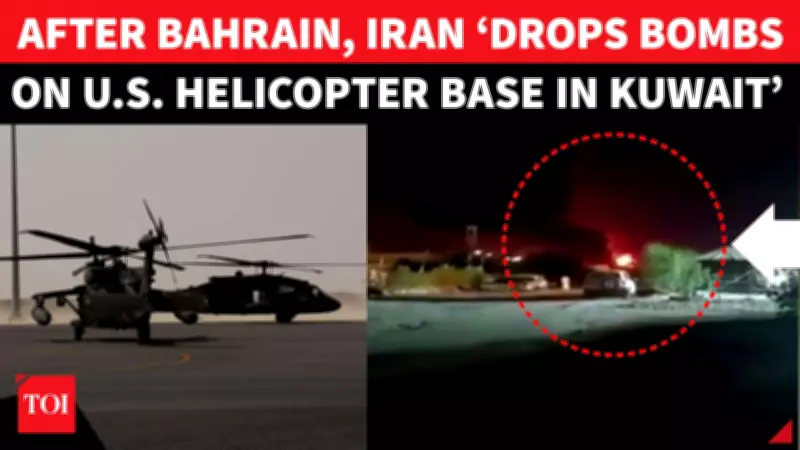
Iran Launches Consecutive Strikes on US Military Installations in Kuwait and Bahrain
In a significant escalation of regional tensions, Iran's Islamic Revolution Guards Corps (IRGC) has executed back-to-back military assaults on United States military facilities in the Gulf. This aggressive action follows a major strike on the U.S. naval base in Bahrain, with the latest target being the strategically vital Al-Udairi helicopter base located in Kuwait.
Precision Attack on Critical US Helicopter Hub
The assault on the Al-Udairi base was characterized by precision drone and missile strikes that specifically targeted essential infrastructure. According to reports, the attack successfully hit helicopter maintenance and refueling facilities, fuel depots, multiple aircraft, and the command building. The impact was so severe that it ignited massive fires, visible from miles away, indicating substantial damage to the base's operational capabilities.
Al-Udairi serves as a critical hub for U.S. rotary-wing aircraft, supporting a wide range of military operations across Iraq and the broader Gulf region. Its strategic importance cannot be overstated, as it facilitates American mobility and logistics, making it a prime target for Tehran's efforts to disrupt U.S. military activities in the area.

Context of Escalating Regional Conflict
This attack is part of a broader pattern of escalating hostilities between Iran and the United States, as well as its allies in the region. The strike on the Bahrain naval base, which preceded the Kuwait assault, underscores Iran's willingness to target multiple U.S. installations in rapid succession. These actions are widely interpreted as a direct response to ongoing geopolitical tensions and previous confrontations.
The timing and coordination of these strikes suggest a calculated strategy by Iran to demonstrate its military capabilities and challenge American presence in the Gulf. By targeting key logistical and operational nodes, Iran aims to impair the efficiency and responsiveness of U.S. forces, potentially altering the balance of power in the region.
Implications for Regional Security and US Operations
The destruction of critical infrastructure at Al-Udairi is likely to have immediate and long-term repercussions for U.S. military operations. The base's role in supporting rotary-wing missions means that any disruption could affect surveillance, troop movements, and emergency response capabilities across Iraq and neighboring areas.
- Disruption of helicopter maintenance and refueling operations
- Potential delays in logistical support for ongoing missions
- Increased security risks for U.S. personnel and assets in the region
- Possible escalation in retaliatory measures from the United States or its allies
Furthermore, these attacks highlight the growing use of drone and missile technology in modern warfare, with Iran showcasing its ability to conduct precision strikes against well-defended military targets. This development raises concerns about the vulnerability of other U.S. bases and allied installations in the Middle East.
Broader Regional Dynamics and Future Outlook
The consecutive strikes on U.S. bases in Bahrain and Kuwait are set against a backdrop of heightened regional instability. Iran's actions are likely to provoke strong responses from the United States and its partners, potentially leading to further military engagements or diplomatic confrontations. The situation underscores the fragile security environment in the Gulf, where any miscalculation could result in broader conflict.
- Iran's demonstration of military prowess through coordinated attacks
- Increased scrutiny on U.S. defense strategies in the Middle East
- Potential for allied nations to bolster their defensive postures
- Ongoing risks to international shipping and energy routes in the region
As tensions continue to mount, the international community will be closely monitoring developments, with a focus on de-escalation efforts and the protection of civilian and military assets. The attacks on Al-Udairi and the Bahrain naval base mark a dangerous new phase in the ongoing geopolitical struggle, with significant implications for global security and stability.






