

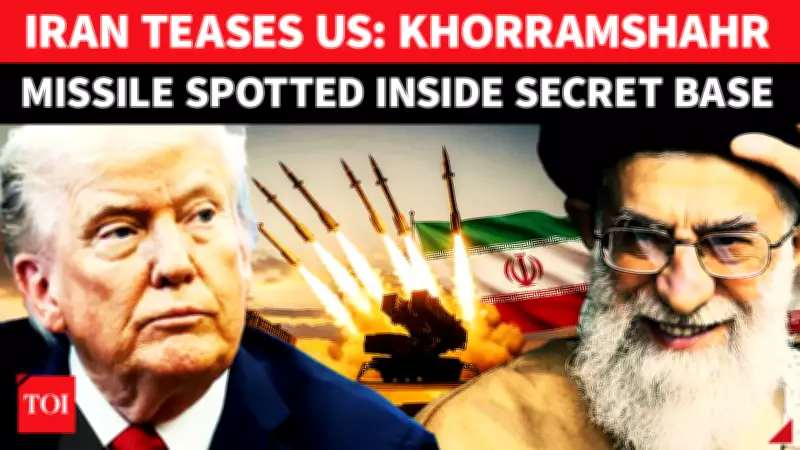
Iran State Television Censors Underground Missile Base Broadcast Following Strategic Weapon Revelation
In a dramatic sequence of events that underscores escalating geopolitical tensions, Iranian state television has abruptly pulled a broadcast featuring the country's top military commander inspecting a secret underground missile base. The footage, which aired briefly, provided the first public glimpse of the formidable Khorramshahr-Four heavy warhead missile concealed within hardened subterranean tunnels operated by the Islamic Revolutionary Guard Corps (IRGC).
Strategic Revelation and Immediate Censorship
The broadcast revealed significant details about Iran's military capabilities, showing the long-range ballistic missile system stored in what appears to be a highly fortified underground facility. However, within hours of the images surfacing, state media authorities removed the content entirely, officially citing "national security considerations" as the reason for the censorship. This rapid reversal has sparked intense speculation about whether the initial broadcast was an intentional display of military strength or an accidental security breach.
Nuclear Diplomacy Unravels Simultaneously
The timing of this military revelation coincides precisely with the collapse of critical nuclear negotiations between Iran and the United States. Scheduled talks for Friday have effectively disintegrated after Tehran presented last-minute demands that fundamentally altered the diplomatic landscape. Iran insisted on shifting the venue from Turkey to Oman, excluding other participating nations from the discussions, and completely removing missile-related issues from the negotiation agenda.

Washington responded with firm rejection of these conditions, with U.S. officials presenting Tehran with an ultimatum: "This or nothing." Iran's leadership chose the latter option, effectively halting diplomatic progress and creating a significant impasse in nuclear negotiations that had shown tentative promise in recent months.
Escalating Tensions and Military Posturing
As diplomatic channels falter, military posturing intensifies on both sides. Former President Donald Trump has reiterated that military options remain actively on the table regarding Iran's nuclear program and regional activities. Meanwhile, Iran's decision to reveal—then hastily conceal—its advanced missile capabilities sends a complex strategic signal that analysts are struggling to interpret.
The Khorramshahr-Four missile represents one of Iran's most formidable weapons systems, with estimated ranges that could threaten regional security architectures. Its placement in hardened underground facilities suggests advanced survivability measures designed to withstand potential military strikes.
Broader Regional Implications
This development occurs against a backdrop of:
- Increasingly hardened diplomatic positions between Iran and Western powers
- Growing concerns about nuclear proliferation in the Middle East
- Regional power dynamics shifting as Gulf states monitor the situation closely
- Potential impacts on global energy markets and security arrangements
The simultaneous collapse of nuclear talks and revelation of advanced missile capabilities creates what security experts describe as a "perfect storm" of escalation factors. The distance between deterrence and direct confrontation appears to be narrowing rapidly, with fewer diplomatic off-ramps available to de-escalate tensions.
Strategic Calculations and Future Prospects
Iran's actions suggest a calculated approach to negotiations, combining military demonstrations with diplomatic inflexibility. This strategy may aim to:

- Strengthen Tehran's bargaining position by showcasing military capabilities
- Test international responses to both technological revelations and diplomatic maneuvers
- Signal resolve to domestic audiences amid economic challenges
- Create negotiating leverage for future discussions under different conditions
As the situation develops, international observers are closely monitoring whether this represents a temporary breakdown in communications or a more fundamental shift toward confrontation. The coming days will likely reveal whether either side demonstrates flexibility or whether the current stalemate hardens into a more permanent diplomatic freeze with potentially dangerous military implications.





