

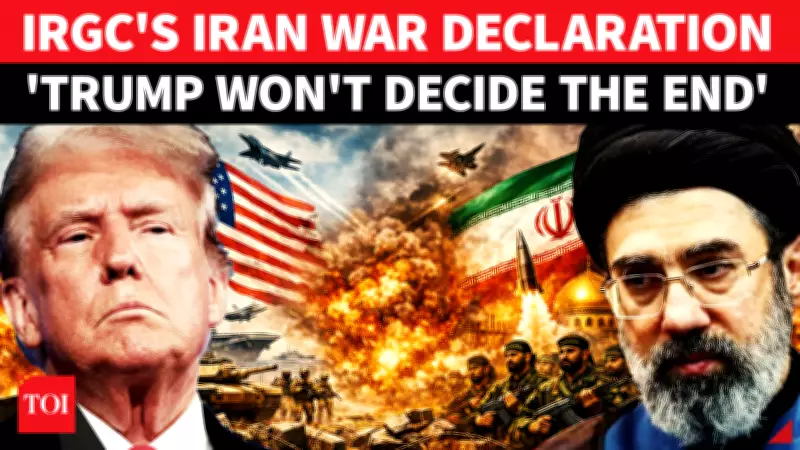
Iran's Revolutionary Guard Challenges Trump's Authority on War Termination
In a sharp rebuke to former U.S. President Donald Trump, Iran's Islamic Revolutionary Guard Corps (IRGC) has forcefully rejected his assertion that the ongoing conflict in the Middle East could soon conclude. The IRGC issued a statement declaring that Washington lacks the authority to determine when the war will end, emphasizing that this decision rests solely with Iran's armed forces.
"Who Are You to Decide?" IRGC Questions Trump's Role
The IRGC's response came after Trump publicly suggested the war might be nearing its end. Iranian officials countered with a pointed question: "Who are you to decide on ending war?" This rhetorical challenge underscores Tehran's position that external powers, particularly the United States, cannot unilaterally dictate the conflict's resolution. The IRGC reinforced that Iran's military leadership will exclusively determine the war's future trajectory and outcomes.
Major Threat to Global Energy Supplies Issued
In a significant escalation, Iran issued a stark warning regarding global energy stability. Tehran declared it would prevent "one litre of oil" from leaving the region if U.S. and Israeli military strikes persist. This threat directly targets the Strait of Hormuz, a critical chokepoint for international oil shipments, through which approximately one-fifth of the world's oil passes. Such a blockade could trigger severe disruptions to global energy markets, potentially leading to price spikes and supply shortages.

Context of Rising Tensions in the Middle East
This exchange occurs amid heightened hostilities in the region, with Iran and its proxies reportedly conducting strikes against U.S. and Israeli interests. Recent incidents include:
- Explosions at Al Udeid Air Base in Qatar, a major U.S. military facility
- Missile attacks targeting Israeli leadership shelters in Tel Aviv
- Drone breaches hitting American bases in Kuwait and Bahrain
- Alleged attacks on a U.S. embassy in Oslo, Norway
Iran has framed these actions as responses to continued aggression, while the U.S. and Israel maintain their operations are defensive measures against Iranian threats.
Implications for International Diplomacy and Security
The IRGC's statements highlight deepening divisions between Iran and Western powers, complicating diplomatic efforts to de-escalate the conflict. By asserting unilateral control over the war's duration and threatening energy supplies, Iran positions itself as a decisive actor unwilling to concede to external pressures. This stance may further isolate Tehran internationally but also demonstrates its readiness to leverage economic tools, like oil exports, as strategic weapons in the geopolitical standoff.
As tensions simmer, the international community watches closely, aware that any move to block oil shipments could have cascading effects on global economies and security arrangements. The situation remains fluid, with both rhetorical volleys and military actions shaping the volatile landscape of Middle Eastern politics.






