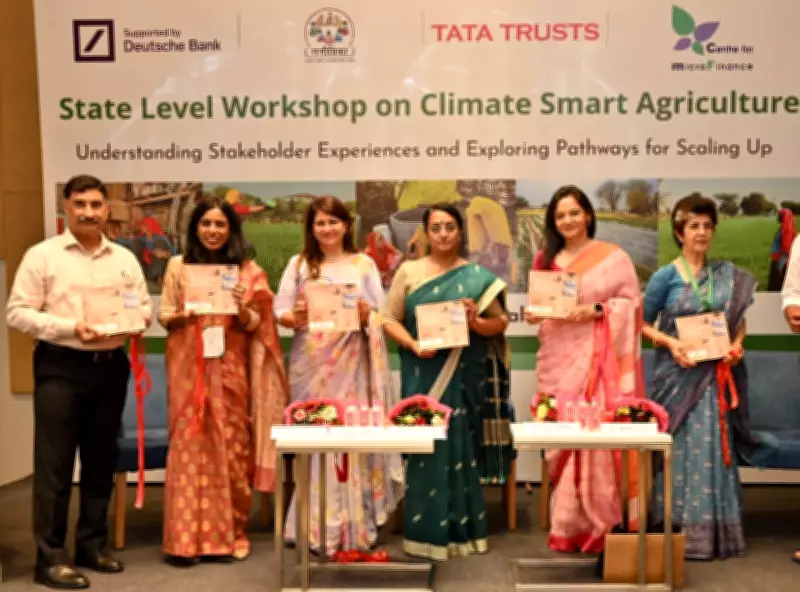
A state-level workshop was held in Jaipur to promote climate-resilient agriculture in Rajasthan amid climate change and increasing pressure on natural resources. Organised by the Centre for Microfinance (CmF), the workshop focused on connecting women farmers with sustainable agricultural practices and strengthening their leadership in the agricultural sector. Held at Hyatt Place, Jaipur, the workshop shared experiences and achievements from a three-year project conducted in the Lalsot block of Dausa district.
Project Supported by Deutsche Bank CSR
This initiative, supported by Deutsche Bank’s Corporate Social Responsibility (CSR) program, provided training and support to over 4,000 women farmers from over 60 villages to adopt water conservation, soil health, and sustainable agricultural techniques. The event also saw the release of an Impact Story Book, which captures the project’s achievements and stories of change.
Chief Guest Calls for Economic Empowerment
Chief guest Priyanka Goswami, State Mission Director of the Rajasthan Rural Livelihoods Development Council (Rajivikas), called on women farmers to organize and become economically empowered and move towards becoming a “lakhpati farmer.” Emphasizing the need to provide better markets for women farmers’ produce, she explained that Rajivika is soon developing an e-portal through which women farmers will be able to sell their produce domestically and abroad.

Deutsche Bank CSR Head Highlights Opportunities
Ruchi Khemka, Head of CSR, Deutsche Bank Group India, stated that this initiative has opened new opportunities in agriculture and related sectors for thousands of women farmers, and has enhanced women’s confidence and leadership.
CMF Executive Director on Role of Rural Communities
Malika Srivastava, Executive Director of CMF, stated that with appropriate knowledge, technology, and institutional support, rural communities can play a vital role in strengthening livelihoods and conserving natural resources.
Panel Discussions and Expert Insights
Panel discussions held at the workshop included women farmers, agricultural experts, agri-tech companies, government officials, and CSR representatives. Participants shared experiences on topics such as micro-irrigation, natural farming, biogas, and collective enterprise models, and discussed the expansion and challenges of climate-resilient agriculture. Experts emphasized the need for better coordination among various stakeholders to increase access to sustainable agricultural technologies for small and marginal farmers.