Karnataka has officially commenced the monumental sixth All-India Tiger Estimation (AITE) across its five tiger reserves and other protected forests. This quadrennial national exercise, which began on Monday, marks a crucial step in assessing the health of India's big cat population, with Karnataka keen to reclaim its top spot from Madhya Pradesh.
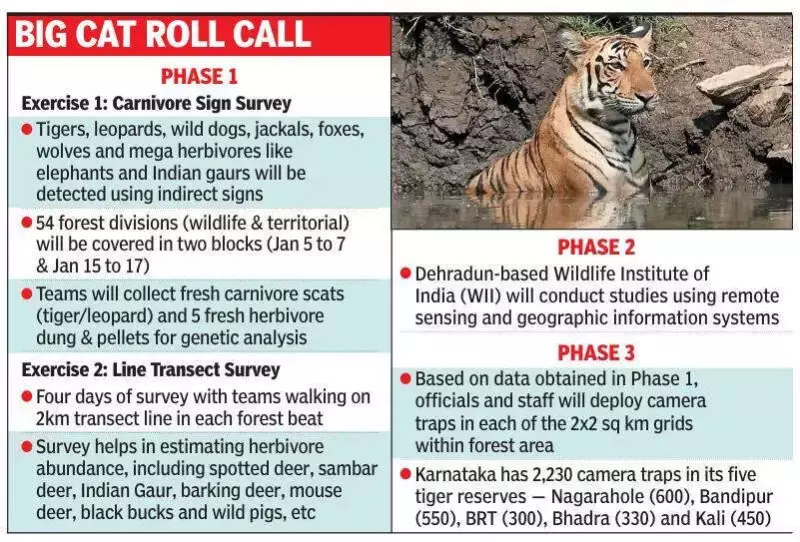
Phased Approach and Extensive Preparations
The forest department has launched the first phase of the census, which will be followed by two more phases. The final results of this extensive wildlife survey are scheduled for publication in 2027. Karnataka began its groundwork four months prior, with intensive training programs for frontline staff.
Forest Minister Eshwar Khandre revealed that about 61 frontline staff and officials were trained at a 'Training of Trainers' workshop held at the Bandipur–Mudumalai Tiger Reserve in September 2025. These master trainers then cascaded their knowledge, training personnel across all 13 forest circles between October and December last year.

For the initial phase, forest personnel are working in teams of three, trekking approximately 5 kilometers daily along assigned beats. Their task is to meticulously document signs of tigers, leopards, and other predators by recording pugmarks, scat, and dung, and photographing animals when possible.
Scientific Enhancements and Carrying Capacity Assessment
A significant development in AITE-2026 is the directive to estimate the carrying capacity of the forests. This scientific assessment, prompted by rising human-wildlife conflict and growing animal populations, will evaluate how many tigers the forests can sustain based on prey availability and forest cover.
"This scientific assessment will help us understand key issues and arrive at practical solutions," Minister Khandre stated, highlighting its importance for conflict mitigation and conservation planning.
The second phase, set for January 15 to 17, will focus on estimating the prey base across 14 forest divisions to identify ideal locations for camera traps. The department has also introduced new tools for surveyors, supplying 380 see-through compasses and 360 range finders for the first time to aid in transect surveys for herbivore populations. Fresh scat and dung samples will be collected for advanced DNA analysis.
Expanding Reach and Coordinated Leadership
Recognizing that tigers are increasingly moving beyond reserve boundaries, the state government has mandated the deployment of camera traps in semi-forest and fringe areas as well. Cameras will be sourced from adjoining tiger reserves after the core estimation is complete. For instance, Cauvery Wildlife Sanctuary will get cameras from Bandipur, while Nagarahole Tiger Reserve will support neighboring territorial divisions.
To supervise this massive coordination effort, Karnataka has nominated Conservator of Forests Ramesh Kumar P, IFS, as the nodal officer to liaise with the National Tiger Conservation Authority (NTCA).
Karnataka, which proudly held the title of 'Tiger Capital of India' twice, was surpassed by Madhya Pradesh in the 2022 census (785 tigers vs. Karnataka's initially reported 524). However, a subsequent data revision placed Karnataka's count at 563 tigers. The state government now expresses confidence in reporting a significant increase in tiger numbers from this latest, more comprehensive estimation.