

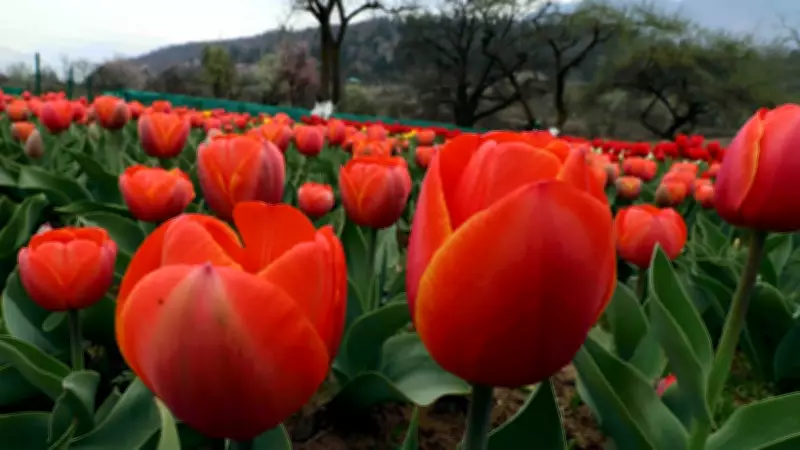
Kashmir Defies Nature: Tulips Bloom in December for First Time, Months Ahead of Spring
In a remarkable horticultural achievement, Kashmir has witnessed tulips blooming in December for the first time, nearly four months ahead of their natural spring season. This breakthrough, achieved through advanced floriculture techniques, is set to revolutionize the region's floral tourism and flower production industry.
Breakthrough at SKUAST Experimental Garden
According to professors at the Sher-e-Kashmir University of Agricultural Sciences and Technology (SKUAST) in Srinagar, the milestone was accomplished at the institute's experimental garden. Imtiyaz Nazki, a professor and head of the Floriculture Department at SKUAST, stated, "We have successfully achieved tulip bloom in December at our research garden. Of the 4,000 bulbs we planted, around 3,000 bloomed. This has been made possible through bulb programming and forcing techniques."
Understanding Bulb Programming and Forcing Techniques
In floriculture, bulb programming is a strategic method used to control the timing of flower production by adjusting environmental factors such as temperature and light, scheduling planting dates, and managing growth stages. Forcing involves manipulating environmental and chemical conditions to induce plants to grow and bloom outside their natural seasonal cycles.

- These techniques enable the production of flower crops to meet specific market demands, particularly during high-demand periods like Christmas, New Year's, and Valentine's Day.
- Nazki explained that in initial experiments, bulbs were programmed for the Christmas and New Year period, with scheduling for 12, 14, and 16 weeks, yielding particularly encouraging results at week 14.
Significance for Kashmir's Floral Tourism
While similar technology is available in the Netherlands, this marks the first successful implementation in the Kashmir Valley. Nazki emphasized, "The breakthrough has significant potential to expand our floral tourism and ensure flower availability during periods of high market demand. We have made a beginning, and now big entrepreneurs need to come forward to translate it into reality."
Traditionally, tulips in Kashmir begin blooming in late March and last for about a month, attracting both locals and tourists. Srinagar's tulip garden recorded approximately eight lakh visitors last year, highlighting its tourism appeal.
Challenges and Future Initiatives
A major challenge remains the local propagation of tulip bulbs, as the Valley currently relies heavily on imports from the Netherlands. To address this, SKUAST has launched a parallel project and established a Centre of Excellence at Sagam village in south Kashmir, with support from the Dutch embassy in New Delhi.
- Nazki noted, "Our focus now is on tulip bulb propagation. Last year, we had one lakh bulbs at the centre for propagation. This is only our second year, and the number has increased to between three and four lakh bulbs this year."
- SKUAST has also made strides in other areas, such as experimenting with chrysanthemum blooms in autumn to attract tourists during the "grey season," an initiative later replicated by the J&K government.
This winter bloom breakthrough not only showcases Kashmir's innovative agricultural capabilities but also promises to enhance its economic and tourism prospects by aligning flower production with global demand cycles.






