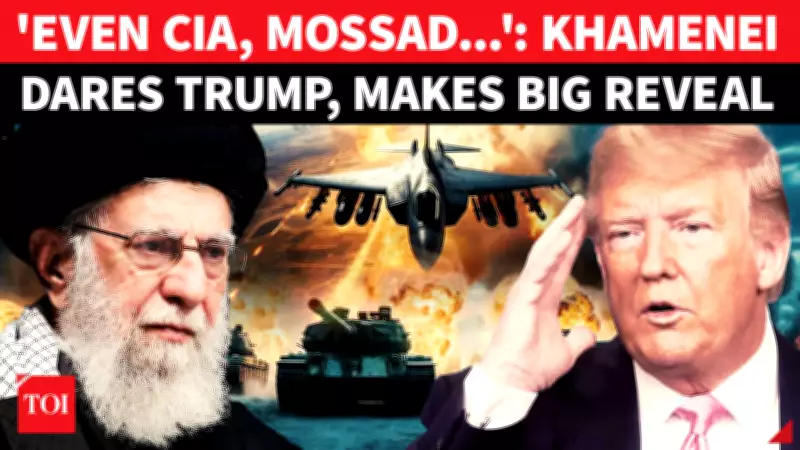
Iran's Supreme Leader Launches Scathing Attack on US and Israel
In a dramatic escalation of rhetoric, Iran's Supreme Leader Ayatollah Ali Khamenei has unleashed a blistering verbal assault against the United States and Israel, making explosive allegations about foreign interference in Iranian affairs. The statements come at a particularly sensitive moment in Middle Eastern geopolitics, even as Tehran appears to signal conditional willingness to re-engage in nuclear diplomacy discussions.
Intelligence Agencies Accused of Covert Destabilization Operation
Khamenei specifically targeted American and Israeli intelligence services in his remarks, claiming that the CIA and Mossad collaborated on a covert operation designed to create internal unrest within Iran. According to the Supreme Leader's statements, this alleged intelligence operation was aimed at fundamentally destabilizing the country's political and social structures.
"Even the CIA, Mossad..." Khamenei reportedly stated, suggesting unprecedented cooperation between these intelligence agencies in what he characterized as a failed attempt to undermine Iranian sovereignty. The Iranian leader asserted that this foreign-backed initiative ultimately ended in failure, though he provided limited specific details about the alleged operation's timeline or methods.

Revival of Controversial ISIS Claims and Protest Framing
In addition to the intelligence agency allegations, Khamenei revived a controversial historical claim that has long been part of Iranian political rhetoric. He once again blamed Washington for the creation of ISIS, framing the terrorist organization's emergence as a deliberate American strategy rather than an unintended consequence of regional policies.
The Supreme Leader further contextualized recent protests within Iran as part of what he described as a foreign-backed coup attempt. This framing represents a significant escalation in how Iranian authorities characterize domestic dissent, potentially justifying more aggressive responses to future demonstrations by linking them to external enemies.
Geopolitical Context and Nuclear Diplomacy Signals
Khamenei's inflammatory rhetoric emerges against a backdrop of heightened regional tensions, with multiple flashpoints across the Middle East creating an increasingly volatile security environment. The verbal attack on the United States and Israel comes despite what appears to be contradictory signals from Tehran regarding nuclear diplomacy.
Iran has reportedly indicated conditional openness to renewed nuclear negotiations with the United States, suggesting a potential diplomatic pathway even as its leadership engages in aggressive rhetoric. This dual-track approach reflects the complex balancing act Tehran must maintain between projecting strength to domestic audiences and pursuing pragmatic foreign policy objectives.
The timing of Khamenei's statements is particularly noteworthy given recent developments in US-Iran relations and broader Middle Eastern dynamics. The allegations about intelligence agency operations represent a significant escalation in Iranian accusations against foreign powers, potentially complicating already delicate diplomatic channels.
As regional tensions continue to simmer, Khamenei's remarks underscore the persistent volatility in US-Iran relations and the broader Middle Eastern geopolitical landscape. The simultaneous signals about potential nuclear diplomacy create a confusing picture of Iranian intentions, leaving international observers to decipher whether Tehran is preparing for confrontation or positioning itself for negotiation.