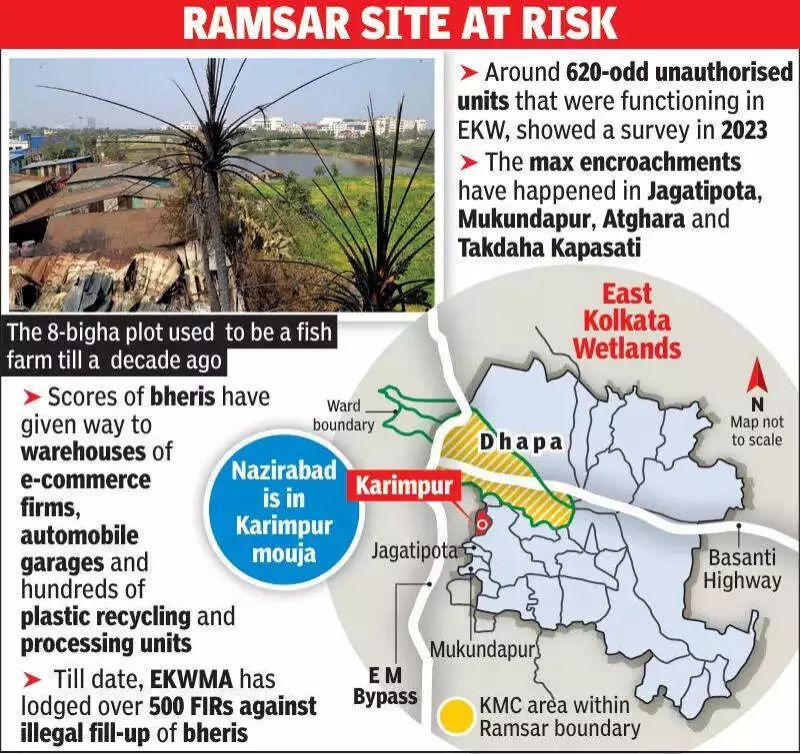
A devastating fire that consumed two large godowns in Nazirabad, Kolkata, has cast a harsh spotlight on the systematic destruction of protected wetlands in the city. The incident occurred on an 8-bigha plot that, until just a decade ago, functioned as a productive bheri, or traditional fish farm. This is not an isolated case; scores of these vital water bodies across the belt have been filled in over the past ten years, making way for a sprawling landscape of e-commerce warehouses, automobile repair garages, and hundreds of plastic recycling and processing units.
Official Acknowledgment of Wetland Violations
An official from the East Kolkata Wetland Management Authority (EKWMA) confirmed that the two burnt godowns, located in the Karimpur mouja under Kheyada 2 gram panchayat, were illegally situated within the internationally recognized wetland, a designated Ramsar site. "Any plot that lies beyond the Urbana housing complex is in the wetland. Since encroachments were taking place, the EKW boundary was demarcated here in 2022. But encroachment continues unabated," the official stated, revealing that EKWMA has lodged over 500 First Information Reports (FIRs) against the illegal filling of bheris to date.
Local Testimonies and Rapid Urbanization
Local residents corroborate this alarming transformation. One inhabitant noted, "The waterbody was filled up about a decade ago. Both godowns have been operating for about seven-eight years. Plots of many houses or apartments that have come up in this area are wetlands." Samir Raha, a shopkeeper operating merely 100 meters from the fire site, recounted how factories, godowns, and residential buildings mushroomed rapidly once the water bodies were obliterated. "Over the years, the population of this area has also increased," he added, highlighting the compounded pressure of urbanization.

Survey Reveals Scale of Unauthorized Development
The two destroyed godowns were among approximately 620 unauthorized units identified as functioning within the East Kolkata Wetlands during a 2023 survey conducted by the Society for Creative Opportunities and Participatory Ecosystems (SCOPE). Disturbingly, the situation has worsened since. "Since then, we estimate at least 200 more units have sprung up," disclosed SCOPE project director Dhruba Das Gupta, indicating a relentless pace of illegal construction.
Road Development Fuels Further Encroachment
The proliferation of unauthorized development has been significantly accelerated by the construction of three key roads over the past decade. The first road extends from near the Urbana complex to the Basanti Highway. "Almost all the bheris that were there in this area have shrunk or disappeared," lamented Das Gupta. A second road connects Bantala to Sonarpur station via Jalpath, Kheyada High School, and Tolly Nullah, while a third runs along the Tolly Nullah, widened post-dredging in 2017. These infrastructures have opened up previously inaccessible areas, leading to maximum encroachments in localities like Jagatipota, Mukundapur, Atghara, and Takdaha Kapasati.
Expanding Residential Encroachment
Other affected zones include the Hatgachha mouza under Bamanghata gram panchayat. A SCOPE census in 2021-22 documented 1,662 households in this area, with locals suggesting the number may have doubled by now, underscoring a rapid residential takeover. Furthermore, the Dhapa Manpur mouza, now under the Bidhannagar Municipal Corporation, has witnessed extensive urbanization and loss of productive land. As the largest mouza within the EKW, it also houses the biggest remaining bheris, making its degradation particularly critical.
This fire incident in Nazirabad serves as a stark reminder of the ongoing environmental and regulatory crisis in Kolkata's wetlands. The conversion of ecologically crucial fish farms into unauthorized industrial and residential hubs not only violates international Ramsar conventions but also poses significant risks to local biodiversity, water management, and community safety, as evidenced by the recent blaze.