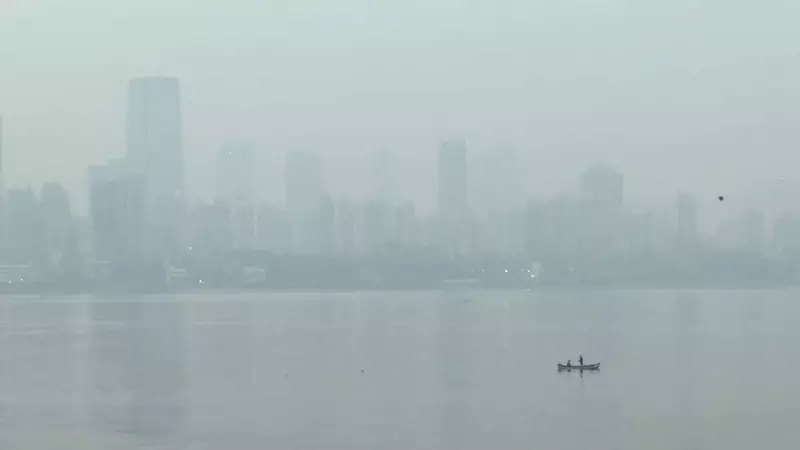
Mumbai residents woke up to a thick layer of haze on Sunday, January 4, as the city's air quality took a severe turn for the worse. Data from the Central Pollution Control Board (CPCB) revealed a significant deterioration, with the overall Air Quality Index (AQI) plummeting to 144 by evening.
Sharp Decline After Brief Improvement
This sharp decline comes just two days after the city enjoyed relatively cleaner air. On January 1, Mumbai recorded an AQI of 90, which improved further to 79 on January 2. This brief respite was attributed to unseasonal showers that occurred on New Year's Day. However, the cleaner phase was short-lived, with pollution levels rebounding dramatically over the weekend.
City-Wide Pollution Hotspots
Out of the city's 30 monitoring stations, 24 were active on Sunday. The data painted a grim picture across most localities. Only one area, Powai, managed to record an AQI below 100, which is classified as 'satisfactory'. The rest of the city struggled with 'moderate' to nearly 'poor' air quality.

The worst-affected area was Byculla, where the AQI soared to 194. It was closely followed by Malad West near Mindscape at 184 and the Mazgaon belt at 171. Key infrastructure points were also impacted, with Mumbai airport recording an AQI of 169 and Vile Parle at 160. The widespread pollution led to visibly reduced visibility across the metropolitan region.
Understanding the AQI Scale and Pollutants
According to CPCB standards, an AQI between 101 and 200 is considered 'moderate', which can cause breathing discomfort to people with lung, heart, or older adults. The primary pollutants identified in Mumbai's air on Sunday were PM 2.5 and PM10 – fine particulate matter that can penetrate deep into the lungs and bloodstream.
Meteorological Factors and Forecast
Meteorologists from the India Meteorological Department (IMD) have pinpointed the cause of the haze. Reduced wind speeds over the city are trapping suspended pollutants in the lower atmosphere, preventing their dispersal. The IMD forecast suggests that Mumbai is likely to experience "partly cloudy skies with haze" until at least January 6.
While a minor improvement in visibility is expected briefly, the haze is predicted to make a comeback starting January 10, indicating that relief will be temporary.
Neighbouring Areas Also Affected
The pollution was not confined to Mumbai city limits. Neighbouring Navi Mumbai also recorded poor air quality, with an overall AQI of 153 on Sunday evening. Within Navi Mumbai, the situation was even more critical at some stations. The Maharashtra Pollution Control Board (MPCB) stations in Sanpada and Nerul breached the 200-mark, logging 'poor' AQIs of 215 and 209 respectively.
The rapid decline in air quality serves as a stark reminder of the city's persistent pollution challenges, especially during the winter months when meteorological conditions often exacerbate the problem.