

Nagpur's Parking Chaos Emerges as Major Driver of Air Pollution Crisis
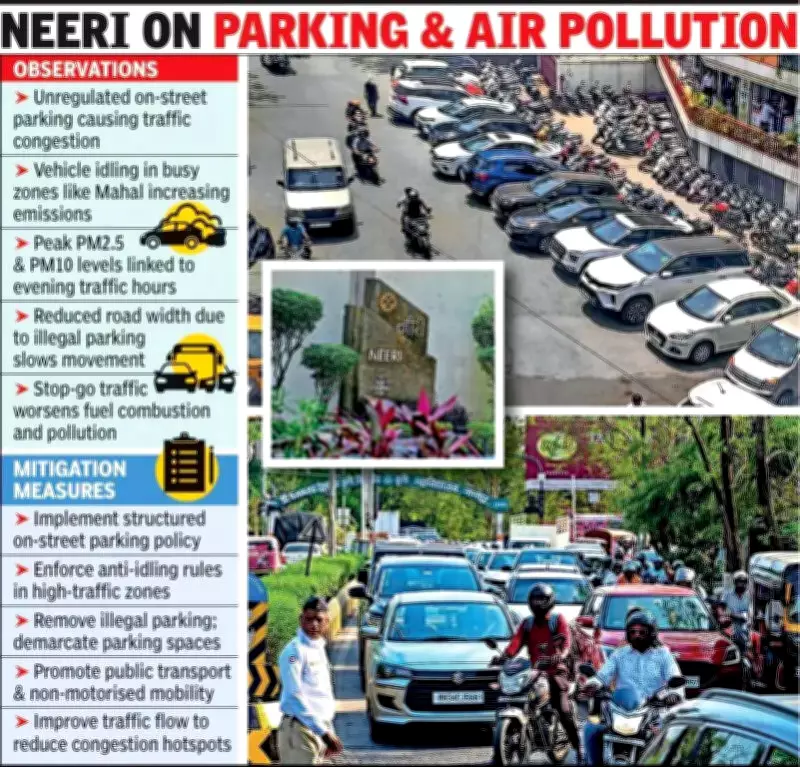
Nagpur: Unregulated on-street parking and severe traffic congestion are now being identified as hidden yet powerful drivers of deteriorating air quality in the city. The recently released Environment Status Report (ESR) for 2024-25 has flagged vehicle idling as a key contributor to escalating particulate matter pollution, transforming everyday mobility issues into a pressing environmental emergency.
Idling Vehicles Spike Particulate Matter Levels
Prepared by the National Environmental Engineering Research Institute (Neeri), the comprehensive report details how poor parking management is exacerbating already critical PM2.5 and PM10 pollution levels. The analysis reveals that areas with intense commercial activity, particularly congested market zones like Mahal, experience prolonged vehicle idling due to the complete absence of a structured parking policy.
Vehicles trapped in traffic jams or circling endlessly for parking slots continue emitting harmful pollutants, significantly increasing localized pollution concentrations during peak evening hours. The ESR's examination of diurnal trends demonstrates that particulate matter levels spike dramatically after 6 PM, precisely coinciding with peak traffic movement and return trips by traders and commuters.

Choke Points Where Emissions Accumulate
This dangerous pattern, combined with Nagpur's narrow roads and haphazard parking practices, creates numerous choke points where vehicle emissions accumulate instead of properly dispersing. Environmental experts involved in the study emphasize that while moving vehicles certainly contribute to emissions, stationary or slow-moving vehicles in congested zones release a disproportionately high amount of pollutants per kilometer traveled.
The frequent braking, acceleration cycles, and extended engine idling in these conditions further intensify emission outputs, making traffic congestion a major environmental concern rather than merely a transportation inconvenience. The ESR specifically points out that the lack of designated parking zones forces vehicles onto road edges, reducing effective carriageway width and dramatically slowing overall traffic flow.
Environmental Consequences of Parking Mismanagement
This parking-induced congestion not only increases travel time for all road users but also multiplies emission loads in dense urban pockets. Urban planners and environmental scientists now argue that parking management must be treated as an urgent environmental priority. Without immediate intervention, the combination of rising vehicle numbers and limited road space could further aggravate pollution levels, particularly during winter months when atmospheric dispersion conditions are naturally poor.
With particulate pollution already consistently breaching Central Pollution Control Board safety norms, the ESR makes it unequivocally clear that tackling parking chaos represents a low-hanging but critically important step toward improving Nagpur's overall air quality.
Recommended Solutions and Policy Interventions
To address this growing crisis, Neeri has recommended the urgent implementation of a comprehensive on-street parking policy with multiple coordinated measures:
- Clearly demarcated and regulated parking spaces throughout the city
- Strict enforcement against illegal parking with meaningful penalties
- Introduction of anti-idling regulations specifically in high-traffic commercial areas
- Promotion of public transportation systems and non-motorized mobility options to reduce overall vehicular load
The findings are expected to spark considerable debate in the upcoming Nagpur Municipal Corporation general body meeting, where the Environment Status Report will be formally tabled for discussion and potential policy action. As Nagpur grapples with its air quality challenges, the connection between parking management and environmental health has never been more clearly established or urgently relevant.






