

Nagpur Stone Crushers Violate Environmental Norms, Worsening Air Quality Crisis
Stone crusher units operating on the outskirts of Nagpur are allegedly flouting environmental norms established by the Maharashtra Pollution Control Board (MPCB) and the Central Pollution Control Board (CPCB). This widespread non-compliance is significantly worsening air quality and exposing thousands of residents to severe health risks across multiple districts.
Major Violation Clusters Identified in Hingna, Umred, and Kalmeshwar
Major clusters violating pollution norms have been reported at Hingna, Umred tehsil, and Kalmeshwar tehsil. In these areas, crushing units function in close proximity to active mining sites and dense human settlements, creating a dangerous overlap of industrial activity and residential zones.
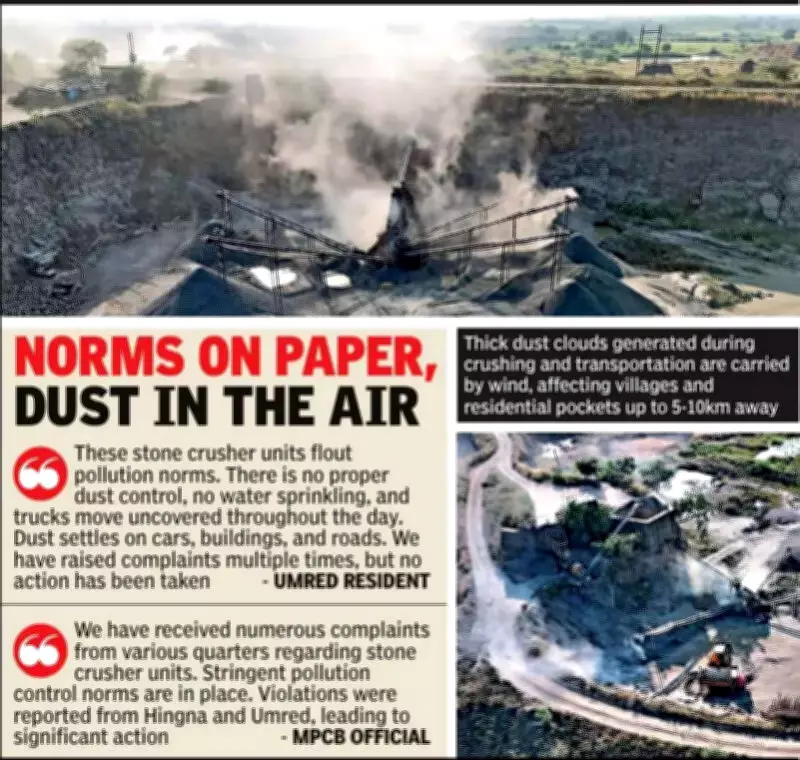
Despite clear guidelines mandating dust suppression systems, green belts, covered conveyor belts, and regulated transportation of crushed material, numerous units continue to operate with little or no compliance, according to local residents. Thick dust clouds generated during crushing and transportation operations are carried by wind patterns, affecting villages and residential pockets located up to 5-10 kilometers away from the actual crusher sites.

Nagpur Records Worst Air Quality Spells in Vidarbha Region
The issue assumes critical significance as Nagpur has recorded some of its worst air quality spells since the beginning of the current year. The city has experienced multiple consecutive days in the poor Air Quality Index (AQI) categories, making it the worst-hit urban center in the entire Vidarbha region during this period.
Environmental experts point out that unchecked emissions from stone crushers significantly contribute to elevated particulate matter levels, specifically PM10 and PM2.5 concentrations. This impact is particularly pronounced during the dry winter months, though experts note the severity has slightly reduced with the arrival of summer conditions. However, the fundamental problem persists year-round.
Health Risks and Environmental Damage from Crusher Operations
Experts emphasize that stone crusher dust is not confined to the immediate operational site. Fine particulate matter can travel considerable distances through atmospheric circulation, eventually settling on homes, agricultural land, and water sources throughout the region. Additionally, prolonged exposure to these fine particles can trigger and exacerbate various respiratory illnesses, including asthma, bronchitis, and other pulmonary conditions.
"These stone crusher units consistently flout established pollution norms," said a resident from the Umred area, who requested anonymity. "There is no proper dust control mechanism in place, no regular water sprinkling occurs, and transport trucks move uncovered throughout the day. The resulting dust settles on vehicles, buildings, roads, and into our homes. We have raised formal complaints multiple times through proper channels, but no substantive action has been taken against the violators."
MPCB Officials Claim Enforcement Actions Against Violators
Senior officials from the MPCB's Nagpur regional office stated that the regulatory board has been taking consistent action against errant units operating in violation of environmental standards. "We have received numerous complaints from various quarters regarding stone crusher units across the Nagpur region," an official explained. "Stringent pollution control norms are firmly in place. Specific violations were reported from Hingna and Umred areas, leading to significant regulatory action against the responsible parties."
The official further elaborated on enforcement procedures: "We conduct regular inspections and issue show-cause notices to errant units identified during monitoring. If satisfactory compliance is demonstrated afterward, operations are allowed to continue under strict observation; however, complete closure remains the final option for persistent violators. In Nagpur specifically, several stone crusher units have been permanently shut down after repeatedly failing to comply with consent conditions and pollution control norms despite multiple warnings."

The official acknowledged that enforcement remains challenging due to recurring non-compliance patterns and the logistical difficulties of monitoring numerous dispersed units across large geographical areas.
Environmentalists Warn of Escalating Crisis Without Stricter Enforcement
As mining and infrastructure development activity continues to expand around Nagpur, environmental activists warn that failure to strictly enforce stone crushing guidelines could lead to further degradation of air quality and consequent public health deterioration. They have demanded implementation of stricter financial penalties, establishment of continuous real-time monitoring mechanisms, and systematic relocation of non-compliant units away from habitation zones to designated industrial areas.
With AQI levels already raising significant public health alarms, residents and environmental experts alike stress that controlling emissions from stone crushers is no longer an optional regulatory exercise but a critical necessity to prevent a deeper, more persistent air pollution crisis in and around Nagpur. The situation represents a classic conflict between industrial development and environmental protection that requires balanced, enforceable solutions.





