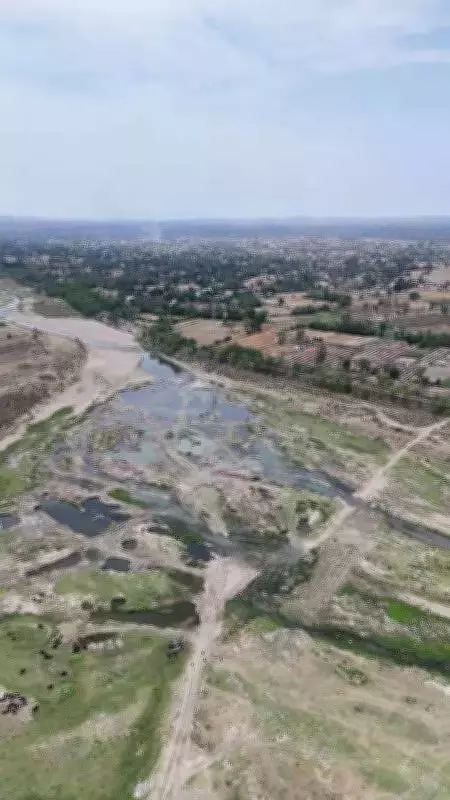
National Green Tribunal Takes Action on Flawed Una District Mining Report
The National Green Tribunal (NGT) has issued formal notices to the Himachal Pradesh government and multiple state departments, including the geological wing and the ministry of environment and forests. This action comes in response to a significant petition challenging the District Survey Report (DSR) for 2024 in Una district, which allegedly facilitates widespread illegal sand mining and stone-crushing operations throughout the region.
Activist's Petition Reveals Critical Flaws in Mining Documentation
Filed by Una-based environmental activist Rohit Katwal — who reported being threatened and physically attacked last year for exposing illegal mining activities — the legal plea seeks to invalidate what it describes as a "fundamentally flawed" report. The petition makes several serious allegations:
- The 2024 DSR appears largely copied from the 2017 version without proper updates
- It lacks realistic calculations of mineral potential in the district
- Mandatory scientific assessments have been omitted entirely
- The document has directly enabled environmentally unsustainable mining practices
A District Survey Report serves as a crucial scientific document that identifies areas with mineral potential while establishing strict limits on extraction quantities, maximum mining depths, and operational conditions. All mining activities within a district must comply with DSR rules and guidelines, making its accuracy essential for environmental protection.

Scientific Omissions and Regulatory Failures Detailed
The petition specifically highlights that the 2024 DSR fails to document essential field surveys that should be conducted every five years in rivers and rivulets during both pre-monsoon and post-monsoon seasons. These surveys are critical for establishing accurate annual replenishment rates of minerals in riverbeds.
Furthermore, the report completely lacks any carrying capacity assessment for hill slope mining, a mandatory requirement under the Enforcement and Monitoring Guidelines for Sand Mining (EMGSM) established in 2020. "Nowhere in the report is there any section, table, or annexure that presents a calculation or scientific analysis of carrying capacity for hill slopes," states the petition, emphasizing that unlike riverbeds, hill slopes do not undergo natural replenishment and therefore require site-specific ecological limits.
"The omission of the mandatory replenishment study of the riverbeds and assessment for hill slope mining undermines the credibility and environmental sustainability of the DSR, 2024," the petition adds, pointing to fundamental failures in environmental governance.
Systematic Environmental Damage and Regulatory Collapse
The petition details how the absence of scientific carrying capacity studies for hill slopes has resulted in rampant mining by stone-crushing units for both dressed and undressed stone, causing severe environmental degradation throughout Una district. Extensive tree cutting and vegetation destruction by unregulated stone-crushing units have transformed once-forested areas into barren landscapes while displacing wildlife populations.
Rohit Katwal submitted numerous complaints in 2025, supported by drone footage, videos, and photographic evidence of illegal mining activities on both riverbeds and hill slopes, to multiple authorities including the mining department, local administration, police, and the ministry of environment and forests. Despite this compelling evidence, no substantive action was taken against the violators.
The petition further reveals that the 2024 DSR violates EMGSM guidelines by failing to include non-village routes for mineral transportation or documenting whether any public hearings occurred before the report's finalization.

Una District: Epicenter of Mining-Related Ecological Crisis
Una district has emerged as one of the worst-affected regions regarding illegal mining in Himachal Pradesh. Successive governments have failed to prevent illegal mining activities along the Swan river and its tributaries, as well as in the district's hills. In 2021, the NGT imposed a complete three-month ban on mining in the Swan river, yet illegal operations continue unabated despite multiple tribunal orders.
The petition describes a systematic collapse of regulatory enforcement, with an estimated 500-1,000 tippers transporting raw material mined from riverbeds in Himachal's border districts to neighboring Punjab every night. This large-scale illegal transportation occurs openly despite the presence of mining staff and police, resulting in significant revenue losses and environmental damage while demonstrating complete regulatory failure.
Most crushing units are strategically located in Una's Haroli and Gagret areas near the Punjab border, facilitating illegal transportation to neighboring districts including Hoshiarpur, Rupnagar, and Pathankot. The petitioner submitted Google Earth images showing multiple alternative routes used by mining operations to transport materials into Punjab, yet authorities took no action.
Extensive Deforestation Mirrors National Ecological Disasters
Unregulated illegal mining activities in the eco-sensitive lower Shivalik hills of Una district — which extend into Hoshiarpur and Rupnagar districts of Punjab — have caused extensive deforestation and ecological degradation. The petition warns that the current situation in Una, driven by mining operations, threatens the district with ecological disaster similar to what has occurred in the Aravalli hills region.
Legal Remedies and Environmental Accountability Sought
The petitioner has requested the tribunal to order a comprehensive assessment of environmental harm and economic losses caused by unscientific and illegal mining activities in Una district since the adoption of the DSR 2016 for granting mining leases. The petition further demands identification of all parties responsible for illegal mining and revenue loss — including stone-crushing units and government officials — through a formal inquiry so that environmental penalties can be imposed and financial losses recovered.
This case represents a critical test of environmental governance in Himachal Pradesh, with implications for mining regulation and ecological protection across India's mountainous regions.