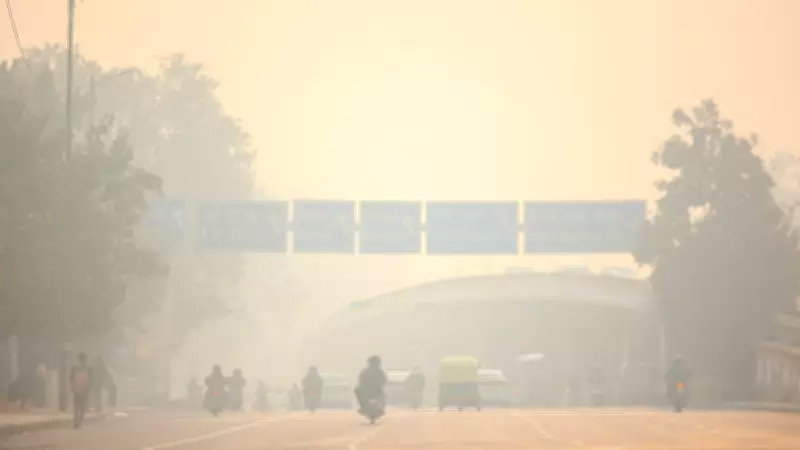
Noida's Air Pollution Action Plan Falls Short on Key Targets Compared to Neighboring Cities
In a stark contrast to its neighbors, Noida's air pollution action plan for 2026 lacks specific PM2.5 reduction targets, raising concerns about its effectiveness in combating hazardous air quality. The Commission for Air Quality Management (CAQM) recently released the State Action Plan 2026 for the National Capital Region (NCR), revealing significant disparities in approach among cities.
Missing Targets and Monitoring Gaps
While Greater Noida and Ghaziabad have outlined clear, measurable goals for reducing PM2.5 levels, Noida's plan merely lists historical PM2.5 data without setting any reduction targets for the current year. Greater Noida aims to lower its annual average PM2.5 concentration from 73 µg/m³ in 2025 to 60 µg/m³ by 2026, with compliance to National Ambient Air Quality Standards (NAAQS) targeted by July 2027. Additionally, it plans to reduce its average Air Quality Index (AQI) to 100 by end-2026, a 31% drop from 2025 levels.
Monitoring infrastructure also shows a sharp divide. Greater Noida has committed to doubling its Continuous Ambient Air Quality Monitoring Stations (CAAQMS) from two to four by June 2026, acknowledging a shortfall. In contrast, Noida, with a larger road network of over 1,143 km compared to Greater Noida's 875 km, deems its existing four CAAQMS and four manual stations sufficient, proposing no expansion.

Transport and Infrastructure Disparities
The gap extends to transport and infrastructure planning. Greater Noida's plan includes quarterly targets for expanding electric vehicle (EV) charging infrastructure and battery swapping stations. However, both Noida and Greater Noida make no provision for operating or introducing electric bus fleets, despite Delhi running over 4,000 electric buses.
On road dust, a major pollution contributor, Greater Noida estimates that 263 km of its 875 km network are in poor condition, requiring Rs. 993 crore for repairs at roughly Rs 3.77 crore per kilometre. Noida's plan states that 176 km of roads need repair, costing Rs 370 crore or about Rs 2.1 crore per kilometre, highlighting a significant cost difference between the two territories.
Criticism and Omissions
Activist Amit Gupta has criticized Noida's plan for failing to address garbage burning, which directly contributes to PM2.5 levels. He noted that around 1,400 incidents of garbage burning have been reported in Noida and Greater Noida over the past two years, yet the action plan lacks a detailed strategy or monitoring mechanism to prevent it. Gupta also flagged transparency issues in the utilisation of Rs 56 crore allocated to Noida under the National Clean Air Programme.
Noida Authority officials responded that they only propose targets and measures to CAQM, with final approval resting with the commission.
Ghaziabad's Ambitious Goals
Ghaziabad, identified as the most polluted city in January by the Centre for Research on Energy and Clean Air (CREA), has set aims to reduce PM10 levels by 20% and PM2.5 levels by 14%. It has mapped over 460 km of roads requiring redevelopment to curb dust resuspension and quantified gaps in mechanical road sweepers, anti-smog guns, and handheld vacuum units due to funding shortages. The city also plans to increase CAAQMS stations from three to five and address a public transport deficit, targeting over 1,100 buses by 2030 from the current 50.
This comparative analysis underscores the need for more robust and transparent air quality management strategies across the NCR to effectively tackle the persistent pollution crisis.