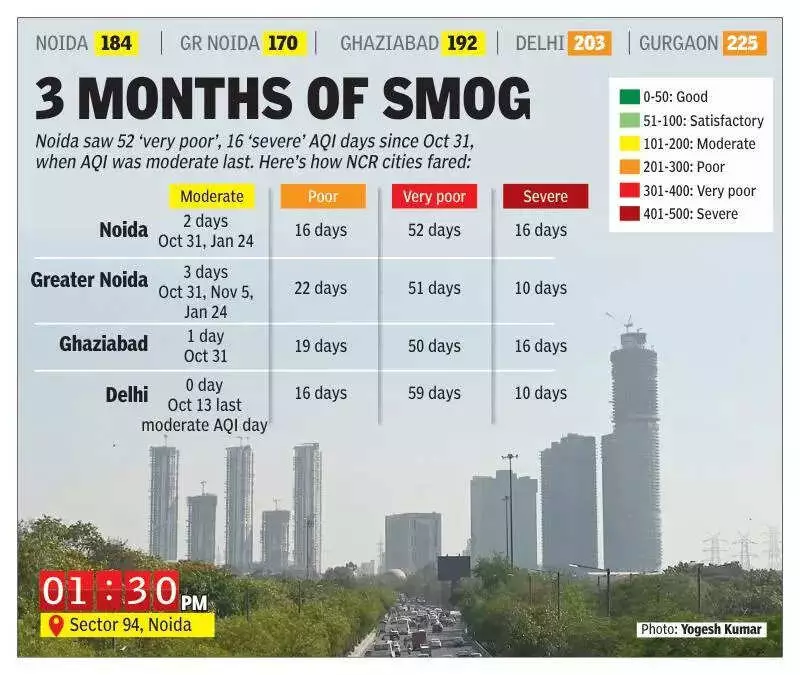
Noida witnessed a significant environmental milestone on Saturday as the city's air quality improved to the 'moderate' category for the first time in 85 days. This marked a dramatic shift from earlier in the week when the Air Quality Index (AQI) had soared above 400, indicating hazardous conditions.
Weather Conditions Drive Improvement
Officials attributed this positive change to favorable meteorological conditions. Intermittent showers on Friday, combined with sustained winds, helped disperse the thick smog that had blanketed the region for months. The winds played a crucial role in clearing pollutants from the atmosphere.
Detailed AQI Readings Across Cities
On Saturday, Noida recorded an AQI of 184, showing substantial improvement from Friday's reading of 270. Greater Noida also experienced better air quality with an AQI of 170, down from 249 the previous day. Ghaziabad showed some improvement but remained at the lower edge of the 'poor' category with an AQI of 203 for the second consecutive day, compared to 278 on Friday.

Station-Wise Analysis
In Noida, several monitoring stations reported moderate air quality levels. Sector 1 recorded 194, Sector 116 registered 186, and Sector 62 measured 172. Data from Sector 125 was unavailable during this period.
Greater Noida's Knowledge Park V recorded an AQI of 185 while Knowledge Park III showed 154, both falling within the moderate range.
Ghaziabad presented a mixed picture. Sanjay Nagar recorded 138, placing it in the moderate category, while other areas including Loni (227), Vasundhara (226), and Indirapuram (221) remained in the poor range.
Historical Context and Comparison
The last time these three cities collectively experienced moderate air quality was on October 31 last year. On that date, Noida recorded 163, Greater Noida 116, and Ghaziabad 177. Following this brief respite, air quality deteriorated to hazardous levels that persisted until January.
Between November 1 and January 23, Noida endured 16 'poor' AQI days, 52 'very poor' days, and 16 'severe' days. Greater Noida faced 22 'poor' days, 51 'very poor' days, and 10 'severe' days, with only one moderate day recorded on November 5. Ghaziabad experienced the most challenging conditions with 19 'poor' days, 50 'very poor' days, and 16 'severe' days during this period.
Delhi's Parallel Improvement
The capital city mirrored this positive trend, recording a sharp improvement in air quality on Saturday. Delhi's AQI touched 192 at 4 PM, representing the cleanest air the city has experienced in 102 days. The last moderate reading in Delhi occurred on October 13 last year when the AQI stood at 189.
The improvement began on Friday under the influence of rain and gusty winds, though the day's average AQI remained poor at 282. On Saturday, winds blew from the northwest at speeds under 20 kmph in the afternoon, easing to around 12 kmph by evening and night, according to officials.
Future Forecast and Concerns
According to the Indian Institute of Tropical Meteorology's Air Quality Early Warning System, the AQI is expected to slip back to the poor category on Sunday. Meteorological predictions indicate a partly cloudy sky with shallow to moderate fog in the morning. Northwest winds are likely to remain below 15 kmph early in the day, dropping to about 10 kmph in the afternoon and further decreasing to around 8 kmph by evening and night.
This temporary improvement highlights how weather patterns significantly influence air quality in the National Capital Region. While residents welcome the cleaner air, experts caution that sustained improvements will require more comprehensive pollution control measures beyond favorable weather conditions.