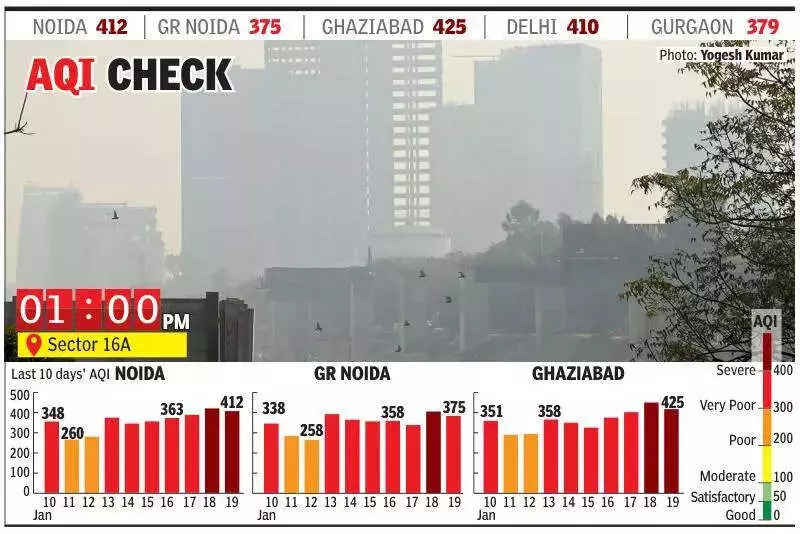
Noida's air quality remained firmly in the 'severe' category for the second straight day on Monday. This followed four consecutive days where the region had recorded 'very poor' air. Visibility conditions were also severely impacted during the morning hours. In some parts of the city, visibility plummeted to as low as 200 meters, creating hazardous conditions for residents and commuters.
AQI Readings Across the NCR Region
The Air Quality Index (AQI) told a grim story across the National Capital Region. Noida logged an AQI of 412, which was a slight improvement from Sunday's reading of 430. Meanwhile, Ghaziabad's AQI shifted to 425 from 458 the previous day. In Greater Noida, the air quality shifted back into the 'very poor' category, registering at 375 compared to 402 on Sunday.
Throughout this month, all three cities have primarily recorded AQI levels ranging between 'poor' and 'very poor'. This persistent pollution has become a major public health concern for millions of residents.

Delhi's Pollution Crisis Deepens
Delhi's AQI was recorded at 410 on Monday, which was marginally lower than Sunday's 440. However, data reveals a troubling trend. The capital is currently witnessing its worst January air quality spell in five years. The situation became so dire that on Saturday, the AQI crossed the 400 mark by 6 pm.
This prompted the Commission for Air Quality Management (CAQM) to enforce Stage-IV measures under the Graded Response Action Plan (GRAP). The last time Delhi experienced a three-day severe pollution spell in January was back in 2021, from January 14th to 16th.
Station-Wise Data Highlights Severe Conditions
Data from the Central Pollution Control Board portal provided a detailed, localized picture of the pollution crisis. In Noida, the Sector 1 air monitoring station recorded an AQI of 438, while Sector 116 registered 415. Both stations reported air quality in the 'severe' range. Sector 62 recorded a slightly better, but still concerning, AQI of 383, placing it in the 'very poor' category. Data from the Sector 125 station was not available for Monday.
The situation in Greater Noida was similarly alarming. Knowledge Park V recorded an AQI of 400, and Knowledge Park III registered 399. Both locations fell within the 'very poor' air quality range.
Ghaziabad faced some of the worst conditions. The Loni station recorded a severe AQI of 454. Indirapuram and Vasundhara followed closely with readings of 433 and 427, respectively, also in the 'severe' category. Only the Sanjay Nagar station reported a 'very poor' AQI of 370.
Forecast Suggests Gradual Improvement
There is a glimmer of hope on the horizon. Forecasts suggest a gradual improvement in air quality over the coming days. The Centre's Air Quality Early Warning System (EWS) projects that the AQI could shift from 'severe' to 'very poor' as early as Tuesday.
According to the Indian Institute of Tropical Meteorology (IITM), Tuesday will bring a partly cloudy sky to the city. Shallow to moderate fog is expected during the morning hours. The predominant surface wind is likely to come from the northwest.
Wind speeds are forecast to reach up to 10 kilometers per hour during the morning. They will then increase to about 15 kmph in the afternoon before decreasing to around 8 kmph during the evening and night. These changing weather patterns could help disperse the accumulated pollutants.
Weather Conditions May Offer Some Relief
Monday's weather saw moderate fog and a noticeable rise in temperature. The maximum temperature reached 26.7 degrees Celsius, while the minimum was recorded at 7.7 degrees Celsius. Looking further ahead, meteorological models suggest Delhi could receive rainfall around January 23rd. Such precipitation would be a welcome development, as it typically helps wash away and disperse harmful pollutants from the atmosphere.
Residents across Noida, Ghaziabad, Greater Noida, and Delhi continue to endure challenging air quality. While forecasts point to a slow improvement, the current 'severe' and 'very poor' conditions underscore the ongoing battle against winter pollution in the National Capital Region.