

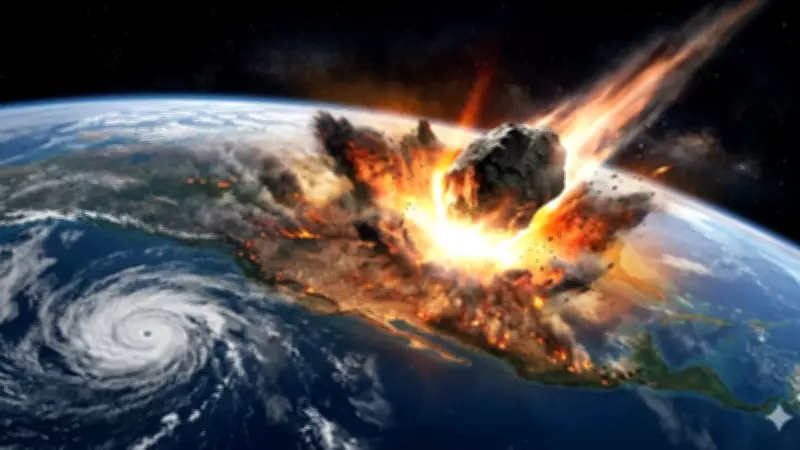
Ancient Asteroid Impact in North Sea Confirmed: Triggered 100-Meter Tsunami
Imagine a space rock the size of a football field hurtling toward Earth and crashing into the shallow seabed of the North Sea between 43 and 46 million years ago. This catastrophic event created a hidden crater and unleashed a tsunami towering over 100 meters tall—higher than many modern skyscrapers. According to a groundbreaking study published in Nature Communications, scientists have finally resolved a two-decade-old debate by confirming this asteroid impact using advanced seismic scans and analysis of shocked minerals.
Discovery of the Silverpit Crater
The Silverpit Crater lies 700 meters beneath the waves of the North Sea, approximately 80 miles off the coast of Yorkshire. First identified in 2002, its three-kilometer-wide bowl and 20-kilometer ring of faults had long puzzled researchers. Initial theories suggested shifting salt layers or volcanic activity, but new evidence points definitively to a hypervelocity asteroid strike.
Dr. Uisdean Nicholson, a sedimentologist at Heriot-Watt University's School of Energy, Geoscience, Infrastructure and Society, led the research. "New seismic imaging has provided an unprecedented view of the crater," he explained. Rock samples from a nearby oil well revealed rare shocked quartz and feldspar crystals—minerals deformed only by the extreme pressures of an impact, akin to finding a needle in a haystack.

The Asteroid Strike and Tsunami Formation
Picture an asteroid 160 meters wide, comparable in length to London's Tower Bridge, approaching from the west at a shallow angle. It struck the seabed with cosmic force, vaporizing rock and water into a plume that soared 1.5 kilometers into the air, momentarily darkening the sky. Within minutes, this massive curtain collapsed back into the sea, generating a tsunami exceeding 100 meters (330 feet) in height.
Dr. Nicholson detailed: "Our evidence indicates a 160-meter-wide asteroid impacted the seabed at a low angle from the west. In just minutes, it erected a 1.5-kilometer-high wall of rock and water that collapsed, producing a tsunami over 100 meters high." At that time, the North Sea basin was shallower, amplifying the wave's destructive power. These mega-waves would have devastated prehistoric coastlines from Britain to Europe, highlighting the far-reaching effects of such impacts.
Scientific Validation and Implications
Professor Gareth Collins of Imperial College London, who initially contested the impact theory in 2009, now celebrates the confirmation. "I always believed the impact hypothesis was the simplest explanation... It is very rewarding to have finally found the silver bullet," he stated. The study integrates seismic data, microscopy, and computer simulations to offer ironclad proof, funded by the Natural Environment Research Council.
This breakthrough not only resolves the long-standing mystery but also enhances our understanding of Earth's dynamic history. Silverpit joins a select group of 33 known submarine craters worldwide, such as Mexico's Chicxulub—linked to dinosaur extinction—and Africa's recent Nadir discovery. Dr. Nicholson noted: "Silverpit is a rare and exceptionally well-preserved hypervelocity impact crater. These are uncommon because Earth's constant changes, like plate tectonics and erosion, erase most traces."
Relevance to Modern Science and Planetary Defense
The confirmation of the North Sea asteroid impact has significant implications for contemporary science. It aids in identifying hidden geological threats and offers insights into how impacts shape planetary interiors, which are challenging to observe on distant worlds like Mars. Professor Collins emphasized: "Now we can use the amazing new data to learn more about how impacts shape planets."
In today's asteroid-vigilant era, Silverpit's story underscores the importance of enhanced monitoring of near-Earth objects. By studying ancient strikes like this one, agencies can improve defenses against potential future cosmic threats. This discovery fuels curiosity about other secrets buried beneath our oceans, reminding us of Earth's tumultuous past and the raw power of natural forces.

The research, led by Dr. Nicholson and his team, provides a vivid snapshot of the chaos that predated human existence along Yorkshire's coast, reshaping our knowledge of asteroid impacts on Earth. It highlights the relentless dynamism of our planet's history and the ongoing quest to unravel its mysteries.





