

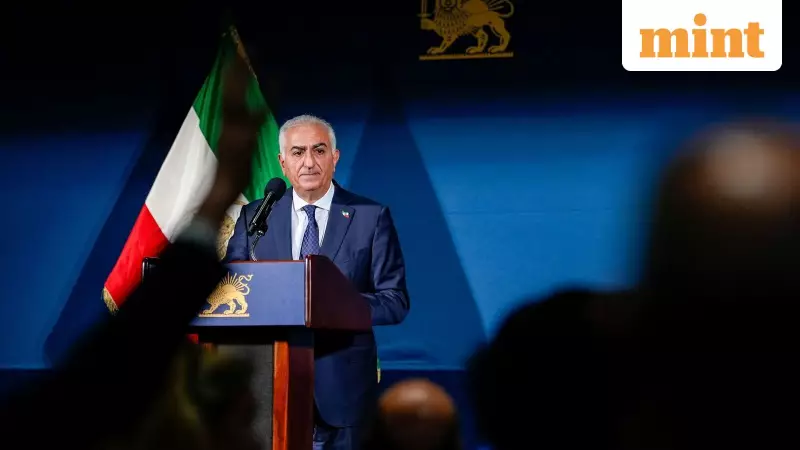
Reza Pahlavi, the leader of the Iranian Democratic Opposition, has made a bold declaration. He says Iran is currently undergoing a revolution. The son of the last shah, once dismissed by many as irrelevant, now believes his moment has finally arrived after nearly five decades of exile.
From 'Clown Prince' to Claimant
For many years, people did not take Reza Pahlavi seriously. Iran's regime, its opponents, and Western diplomats often called him the 'Clown Prince.' They saw him as more focused on his personal life than on reclaiming his father's throne. Reports even placed him on a beach holiday when major protests erupted in Iran last December.
He has spent 47 years advocating for his royal claim, operating from Washington, D.C. Some Iranian exiles in the area describe him and his team as political 'rookies.' Former U.S. President Donald Trump reportedly considers him 'a nice man' but has avoided formal meetings.

A Regime on the Brink
Pahlavi now presents a starkly different picture. In a recent interview with The Economist in Washington, he stated confidently, 'This regime is on the verge of collapse. And what it’s doing right now is a last-gasp effort to intimidate.'
He points to the widespread protests that have shaken Iran. Chants of 'Javid Shah' meaning 'Long live the king' echoed through the streets before a severe crackdown by security forces. Pahlavi claims he helped turn local rallies into a mass mobilization that swept Tehran and other major cities.
The Search for a Savior
Iranians, raised on epic tales of kings and heroes, often look for mythical saviors. In 1979, the untested cleric Ruhollah Khomeini filled that role. Today, Pahlavi positions himself as a potential alternative, but he faces significant challenges.
The current regime has systematically eliminated competition. It has imprisoned dissidents, banned political parties, and even outlawed environmental groups. Public faith in gradual reform within the system has evaporated, despite the elections of presidents like Muhammad Khatami and Hassan Rouhani. Supreme Leader Ali Khamenei's rule has become more absolute, and the economy has deteriorated.
A Plan for Transition
Clean-shaven and wearing Western suits, Pahlavi offers a visual contrast to the bearded, robed supreme leader who rejects ties as symbols of decadence. Like the populist cleric who overthrew his father, Pahlavi claims legitimacy from the people's voices.
He advocates for non-violence and civil disobedience but asserts that people have the right to defend themselves when attacked. 'Khamenei declared war on the Iranian people a long time ago. This is not a foreign enemy, it’s a domestic enemy,' he argues.
His 169-page 'Emergency Phase Booklet,' published in July, outlines a detailed plan. It proposes national reconciliation, integrating the Islamic Revolutionary Guard Corps into the regular army, and retaining most police and civil servants. It warns against vengeance but also suggests vetting minor officials in key ministries and repealing laws against homosexuality.
The Role of a 'Neutral Arbiter'
Pahlavi emphasizes that he sees himself as a transitional figure. He describes his potential role as that of a 'neutral arbiter' leading a temporary government. His plan promises a national referendum within four months to decide between restoring the monarchy or establishing a parliamentary republic.
If voters choose monarchy, he would be crowned two months later. He pledges to establish diplomatic relations with Israel, something his father never did, and abandon Iran's nuclear program in exchange for sanctions relief.
Widespread Skepticism and Challenges
Despite his confidence, Iran's opposition movements remain deeply wary. Ethnic minorities remember his father's suppression of their languages and heritage in the name of Persian nationalism. Kurdish groups, including armed factions, often prefer secession over any centralized rule.
Pahlavi has never successfully united the diverse critics of the regime living in exile. Many doubt his promise to hold a fair referendum, and his supporters sometimes attack other exiles who refuse to endorse monarchy.

Diplomats fear the collapse of another state in the Middle East. Democratic activists aspire to a constitutional assembly and question why they should exchange one supreme leader for another. A popular chant in Tehran captures this sentiment: 'Death to the tyrant, whether Pahlavi or the leader.'
An academic who tried to include Pahlavi in a broader coalition notes that he seems to want a position above others, not beside them. In his interview, Pahlavi insists that Iran's fate lies in the hands of its people. 'Iran’s destiny is not sealed by what any other country does... Our fighting will not stop,' he states.
From his distant vantage point, Reza Pahlavi sounds convinced that a revolution is underway. What remains entirely unclear is what role, if any, he will ultimately play in Iran's turbulent future.





