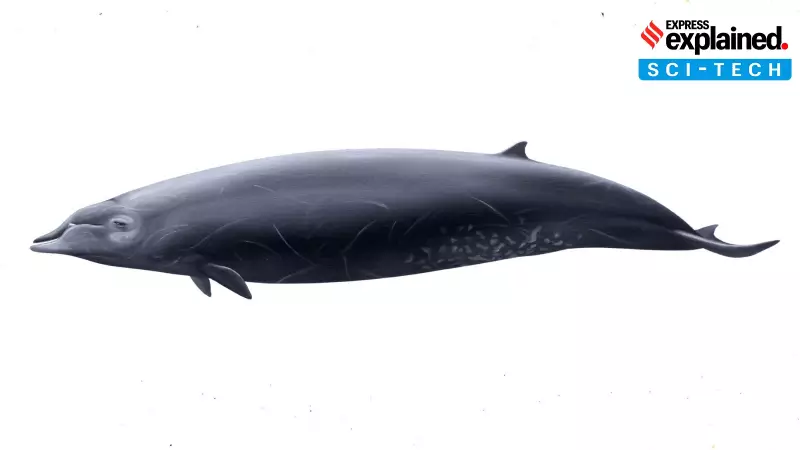
In a landmark breakthrough for marine biology, researchers have recorded the first-ever confirmed sighting of the incredibly rare ginkgo-toothed beaked whale in its natural habitat. This historic encounter occurred in the waters off the coast of Baja California, Mexico, bringing one of the ocean's most mysterious creatures into the light of scientific study for the very first time.
The Elusive Deep-Diver Finally Revealed
The ginkgo-toothed beaked whale, scientifically known as Mesoplodon ginkgodens, is one of the 24 known species of beaked whales. This group of cetaceans is remarkably diverse, ranking as the second most varied group of cetaceans after dolphins. For decades, our entire understanding of this specific whale came from a handful of stranded specimens that washed ashore, providing limited and fragmented data.
To confirm the identity of the whales they encountered, the scientific team employed an innovative method. They used a modified crossbow to collect a tiny skin sample from one of the individuals. This minimally invasive technique allowed for genetic analysis, which definitively confirmed the species. The team's groundbreaking findings were formally detailed in a research paper published in the esteemed journal Marine Mammal Science.

What Do We Know About This Mysterious Whale?
So, what exactly is a ginkgo-toothed beaked whale? Based on the sparse stranding records, scientists believe that both males and females can grow to an impressive length of up to 17.3 feet. Estimates of their weight vary, placing them somewhere between a substantial 1.5 and 3.6 tonnes.
According to descriptions from the UK-based Whale and Dolphin Conservation charity, this species has a robust body and displays less scarring than many of its beaked whale relatives. This characteristic hints at less aggressive behavior between males, possibly because they lack prominent external teeth used for fighting. The males are thought to be a dark blue-black colour with white spots and blotches around the belly, while females are a mid-grey with paler undersides.
Why Is This Sighting So Significant?
The primary reason this sighting is a major scientific event lies in the whale's infamous elusiveness. Beaked whales are the deepest-diving mammals on Earth. They spend the vast majority of their lives in the profound depths of the ocean, only surfacing for brief minutes to breathe, typically far from any coastline. They are also known to be very shy and easily frightened by approaching boats.
As Robert Pitman, a marine ecologist who was part of the discovery team, explained to The Guardian, beaked whales represent a massive gap in public knowledge. "A quarter of all accepted cetacean species are beaked whales, but most people have never even heard of them," he stated, calling them "the largest, least-known animals left on the planet."
Beyond the pure scientific curiosity, this discovery has critical conservation implications. Beaked whales are known to be highly sensitive to military sonar, which can disrupt their feeding and even cause them to surface too quickly, leading to fatal injuries. "Knowing where these whales live can help mitigate the potential harm of sonar by avoiding military training in important beaked whale habitats," the Guardian report emphasized. This first-ever identification in the wild opens the door to learning more about their habitat, which is the first step towards ensuring their protection.