

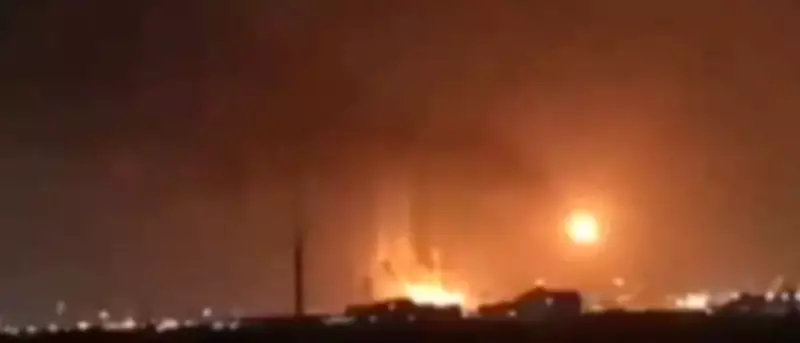
Saudi Arabia Intercepts Seven Ballistic Missiles, Major Fire Erupts at Key Industrial Hub
Saudi Arabia announced on Tuesday that its defense forces successfully intercepted and destroyed seven ballistic missiles launched toward the Kingdom's Eastern Region. While assessments are ongoing to determine the extent of any damage, the attack has already caused significant disruption.
The missiles and accompanying drones – widely suspected to have been launched by Iran – triggered a major fire at Jubail Industrial City, Saudi Arabia's largest industrial hub and one of the world's most significant petrochemical centers. Thick black smoke billowed across the city as emergency crews worked tirelessly to contain the blaze.
Authorities have ordered evacuations in affected areas and suspended nearby industrial operations to prevent potential chain reactions involving critical oil and gas facilities. Local sources indicate that at least one missile may have struck or detonated near vital infrastructure, intensifying concerns about regional energy security.

Heightened Tensions Across the Middle East
These interceptions occur amid escalating tensions across the Middle East, where conflict began with joint US-Israeli strikes on Iran on February 28. Tehran's retaliation has included attacks on Israeli territory and Gulf states hosting US military bases. Jubail Industrial City represents the latest energy hub targeted by Iran during this ongoing conflict.
The Critical Significance of Jubail Industrial City
The importance of Jubail Industrial City cannot be overstated. Established in 1975 and spanning approximately 1,016 square kilometers in Saudi Arabia's Eastern Province, it holds the distinction of being the world's largest single industrial development project.
Saudi Basic Industries Corporation (SABIC) operates multiple petrochemical plants within Jubail Industrial City, accounting for approximately 7% of global petrochemical output. Together with Yanbu Industrial City – Saudi Arabia's second-largest petrochemical hub – these facilities are responsible for about 85% of the Kingdom's non-oil exports.
Additionally, Jubail contributes an estimated 7–12% of Saudi Arabia's annual GDP and accounts for nearly 50% of the Kingdom's total foreign direct investment. The industrial city connects to the King Fahd Industrial Port, which boasts an annual handling capacity of around 70 million tonnes.
Regional Security Measures and International Implications
In response to the heightened threat, Saudi Arabia has closed the King Fahd Causeway, a crucial 25-kilometer bridge linking the Kingdom to Bahrain. The King Fahd Causeway Authority announced the suspension of vehicle movement as a precautionary measure following strikes targeting the Eastern Province.
This bridge represents the only road connection between the Arabian Peninsula and Bahrain, which hosts the US Navy's Fifth Fleet. The closure underscores the serious security concerns gripping the region.
Meanwhile, US President Donald Trump has issued an ultimatum to Iran to reopen the Strait of Hormuz, warning of potential strikes on Iranian power plants and bridges if compliance isn't achieved by Tuesday 8 pm EDT (Wednesday 5:30 am IST). Iran has effectively blockaded this vital sea route in retaliation, threatening approximately 20% of the world's crude oil supply that normally passes through these waters.
The combination of missile attacks on critical industrial infrastructure, strategic bridge closures, and international ultimatums creates a volatile situation with far-reaching implications for global energy markets and regional stability.






