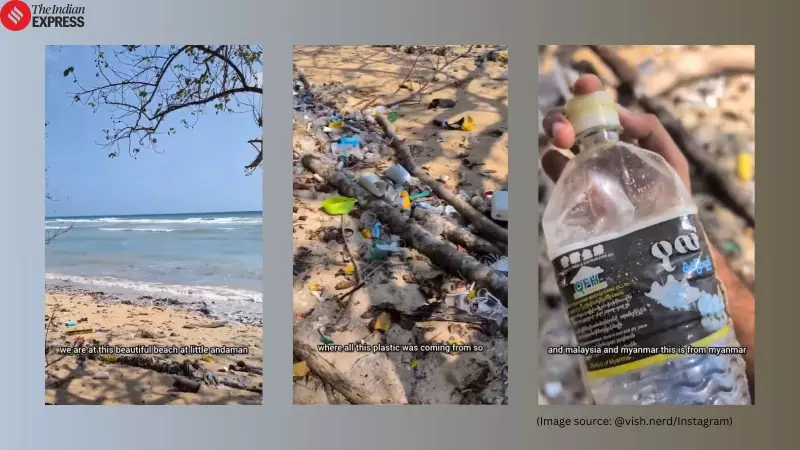
In a powerful visual indictment of global marine pollution, a viral Instagram video has shattered the idyllic image of India's Andaman and Nicobar Islands, revealing pristine beaches littered with plastic debris originating from distant Southeast Asian nations.
Paradise Lost: Plastic Invades Little Andaman
The Andaman and Nicobar archipelago is typically celebrated as a paradise of crystal-clear waters and untouched sandy shores, representing one of India's most remote and ecologically sensitive regions. However, content creator Vishnu's recent experience on Little Andaman Island has exposed a disturbing reality that contradicts this postcard-perfect vision.
Shocking Discovery During Beach Walk
In the widely circulated video, Vishnu and his companions are seen walking along a seemingly beautiful beach on Little Andaman when they encounter massive piles of plastic waste. Driven by curiosity about the origin of this pollution, Vishnu begins meticulously sorting through the trash, examining labels on bottles and various packaging materials.

What he uncovers is both surprising and alarming: a significant portion of the waste appears to come from Southeast Asian countries, specifically Thailand, Malaysia, and Myanmar. "We are at this beautiful beach at Little Andaman, and this beach is littered with plastic," Vishnu explains in the clip. "So, we started collecting some trash, and we realised a lot of it is coming from Thailand, Malaysia and Myanmar."
Transboundary Pollution Problem
Vishnu makes a crucial observation about international perceptions versus realities. He points out that several of these Southeast Asian nations are often viewed as cleaner than India, yet their waste is ending up in oceans and washing ashore in other countries. "A lot of this is not from India. Lot of this is coming from nearby regions," he states, adding important context: "We also contribute to this, it's not like we don't but we should not be blamed 100 per cent for all this."
Ocean Pollution Knows No Borders
The content creator emphasizes that marine pollution represents a shared global crisis that transcends national boundaries. "A lot of other countries are clean on the surface but they are disposing their garbage into the sea too," Vishnu asserts. "No country should be allowed to do this. Sea belongs to everyone." His frustration culminates in a poignant declaration: "We are ruining this world man."
Social Media Backlash and Public Reaction
The video has sparked intense reactions across social media platforms after being reshared by multiple pages. Many users expressed profound disappointment and anger about the condition of these ecologically significant beaches. One commenter proposed practical measures: "India should start charging the near by countries for this mess they are creating by imposing a Environmental harm fee."
Another user highlighted broader responsibility: "This ecological paradise deserves better than being a regional dumping ground. It's time for brands and governments to take responsibility for the full lifecycle of their packaging." A third reaction captured the emotional impact: "That's so sad to see! It's crazy how far plastic travels. We really need to step up and find better ways to deal with waste. Those beaches deserve to be clean!"
Broader Implications for Marine Conservation
This incident underscores several critical environmental issues:
- Transnational waste flow: Plastic pollution travels vast distances through ocean currents
- Shared responsibility: Multiple nations contribute to marine degradation
- Perception versus reality: Countries appearing clean may still contribute significantly to ocean pollution
- Urgent need for international cooperation: Effective solutions require cross-border collaboration
The viral video serves as a stark reminder that even remote, protected areas like the Andaman Islands are not immune to global environmental challenges. It highlights the pressing need for comprehensive waste management strategies, international accountability mechanisms, and greater public awareness about the far-reaching consequences of plastic pollution in our shared oceans.