

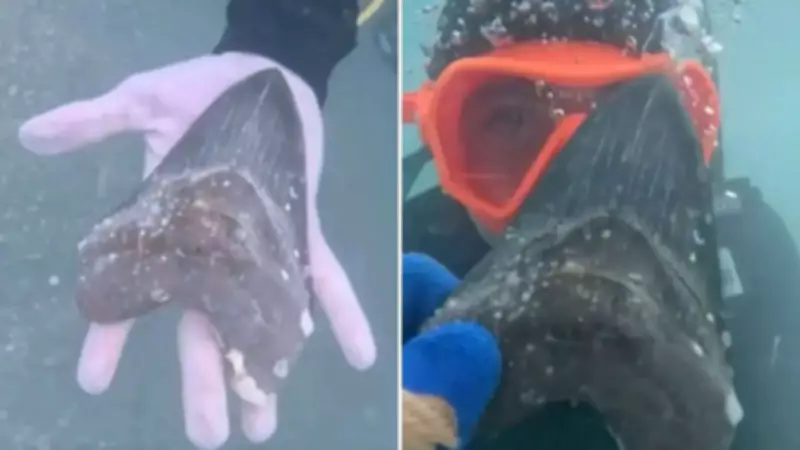
Teen Diver's Rare Megalodon Tooth Discovery Stuns Florida Coast
A routine guided fossil-hunting dive off the coast of Manasota Key, Florida, has transformed into an extraordinary paleontological event that is capturing widespread attention. What began as a typical underwater exploration slowly evolved into a remarkable moment that now seems impossible to overlook. A teenager from Wyoming, diving alongside his father, surfaced with an exceptionally large fossil tooth that experts believe dates back millions of years. As reported by The New York Post, preliminary analyses indicate it likely belongs to Carcharocles megalodon, a species frequently described as the most formidable and powerful shark to have ever inhabited the Earth's oceans.
Unearthing a Prehistoric Giant in Florida Waters
While discoveries of megalodon teeth are not entirely uncommon in Florida's coastal waters, the sheer size and pristine condition of this particular specimen set it apart in a quiet yet profoundly noticeable manner. The dive itself reportedly commenced like numerous others in this renowned area, characterized by slow, methodical movements through the water. Aiden Andrews, a sixteen-year-old participant in a guided group exploring the ocean floor, was accompanied by his father nearby. The process demands immense patience, as divers often expect long stretches of uneventful searching before any significant find.
Initially, the object might not have been immediately recognizable, but once uncovered, its distinct shape became unmistakably clear—a massive shark tooth. Reports suggest it measured close to six inches in length, a size that alone renders it exceptionally rare, even within a region celebrated for its fossil discoveries. The waters adjacent to Manasota Key have steadily cultivated a robust reputation among fossil hunters, as the seabed here appears to harbor layers of ancient material meticulously preserved over extensive geological periods.

The Role of Shifting Currents in Fossil Exposure
Shifting ocean currents appear to play a pivotal role in these discoveries. As sand moves and sediment lifts and resettles over time, objects once deeply buried can gradually resurface. This natural process might explain why smaller megalodon teeth are found with relative frequency in the region, often recovered by divers without excessive difficulty. However, larger specimens like this one are significantly less common, partly due to the degradation of fossils over millennia and their burial at depths beyond typical dive ranges.
Megalodon Shark Facts and the Rarity of Large Teeth
The fossil is believed to originate from Carcharocles megalodon, a species that thrived between approximately 23 million and 3.6 million years ago. Although extinct, its legacy endures through such discoveries. According to the Smithsonian Institution, this colossal shark may have reached lengths of up to 60 feet, with estimates varying slightly but consistently emphasizing its enormous size. Its teeth were evolutionarily designed for function—thick, serrated, and capable of handling large prey. There is a striking contrast that frequently emerges with finds of this nature: while megalodon teeth themselves are not unheard of in Florida, with collectors and divers often seeking them deliberately and some areas hosting regular fossil-hunting tours, larger intact specimens remain a rarity.
Experts suggest that the preservation of such large teeth is uncommon due to natural erosion and burial conditions, making this discovery by a young diver all the more significant. This event not only highlights the rich paleontological heritage of Florida's waters but also underscores the unpredictable wonders that lie beneath the ocean's surface, waiting to be uncovered by patient and observant explorers.






