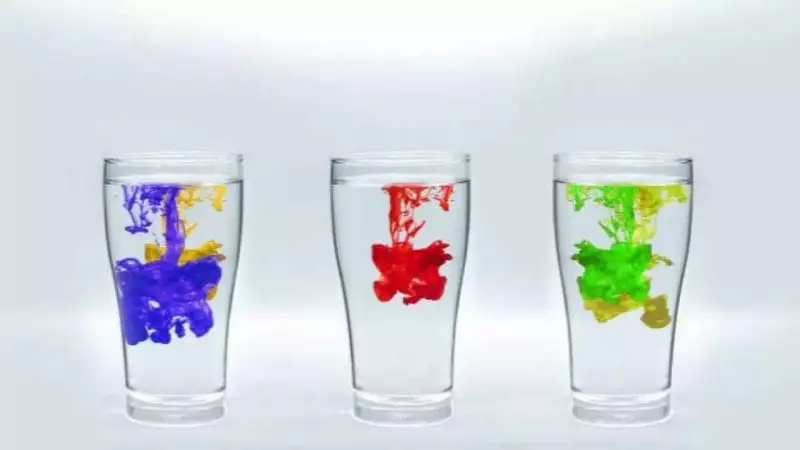
Have you ever paused to wonder about the colour of something as fundamental as water? It seems like a simple question, but the answer reveals a captivating interplay of physics, biology, and our own perception. While we're taught from a young age that water is colourless, our eyes tell a different story when we gaze upon the deep blue sea or a green lake. Let's unravel the science behind water's elusive hue.
The Base Truth: Pure Water is Colourless
In its purest form, water has no colour. This is why a glass of drinking water appears perfectly clear and transparent. The scientific reason is straightforward: a small volume of pure water does not absorb the visible light spectrum in any significant way. Light passes through it largely uninterrupted, allowing us to see through it without any tint. The colourlessness is a property of the water molecules themselves when nothing else is mixed in.
Why Vast Oceans and Seas Paint Themselves Blue
So, why does the open ocean dazzle us with shades of sapphire and azure? The primary reason is selective light absorption. When sunlight, which contains all colours of the rainbow, enters a large body of water, the water molecules absorb the warmer colours—the reds, oranges, and yellows—more efficiently. The cooler blue light is absorbed less and can travel deeper. This blue light is then scattered and reflected back to our eyes, creating the iconic deep blue appearance of seas and oceans.

A common belief is that water simply mirrors the blue sky. While reflection plays a role, especially on calm surfaces, it is a secondary factor. The proof is that water still appears blue on cloudy days, confirming that the intrinsic light absorption within the water itself is the dominant cause of its blue colouration.
The Green and Brown Tints of Rivers and Lakes
Not all water bodies wear blue. Rivers, lakes, and coastal waters often showcase green or brown hues. This shift in colour is due to external elements suspended or dissolved in the water. Algae, phytoplankton, and other microscopic organisms can give water a greenish tint by reflecting green light. Similarly, sediments like mud, sand, and clay can wash into the water, reflecting brown and tan colours. Pollution and dissolved organic matter from decaying plants also contribute to these varied palettes.
The Artificial Blue of Swimming Pools
Swimming pools present another interesting case. The crystal-clear, inviting blue of a pool is often enhanced by design. While the water's depth contributes to a light blue shade through the same absorption process as the ocean, the blue tiles commonly used to line pools play a significant role. These tiles reflect blue light, intensifying the vibrant aqua colour we associate with swimming pools, even though the water itself is technically colourless.
Why Ice and Snow Turn White
If water is clear or blue, why is snow white and ice often appears milky? The transformation occurs due to a change in structure. When water freezes, trapped air bubbles and ice crystals scatter incoming light in all directions. Instead of allowing light to pass through in a straight line (making it transparent), this multi-directional scattering blends all wavelengths of light together, which our eyes perceive as white. The water hasn't changed colour; the way it interacts with light has.
Can water ever truly "have" a colour? In a strict sense, pure H2O does not. However, in nature, water almost always acts as a canvas, its apparent colour dictated by depth, the particles it holds, and the light it interacts with. The simple answer to our curious question is: water is colourless, but it can appear blue, green, brown, or white. This everyday wonder is a beautiful reminder of how science shapes our perception of the natural world.