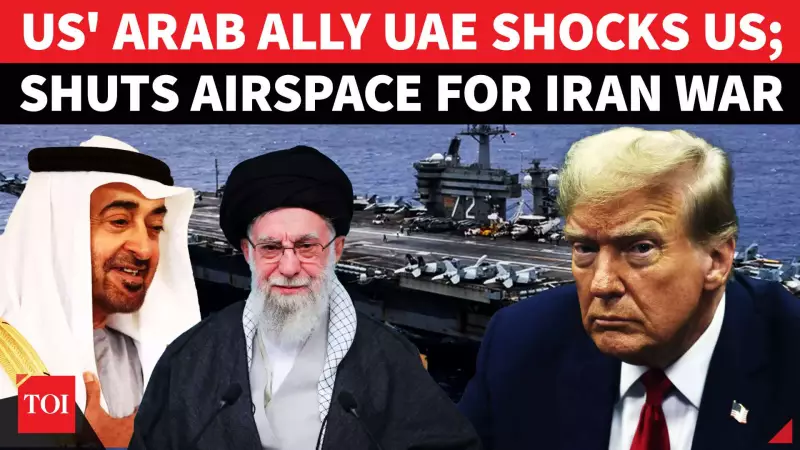
UAE Issues Firm Rejection to US Military Requests Amid Escalating Iran Crisis
The United Arab Emirates has delivered a significant diplomatic rebuff to the United States by explicitly prohibiting the use of its sovereign airspace, territorial waters, and land for any potential military operations targeting Iran. This decisive stance comes as regional tensions approach a critical threshold, with Washington and Tehran engaged in increasingly hostile rhetoric and military posturing.
Abu Dhabi Advocates Diplomacy While Tehran Issues Warnings
Abu Dhabi has consistently emphasized the necessity of dialogue and de-escalation as the preferred pathway to resolve the mounting crisis. In stark contrast, Iranian authorities have broadcast ominous warnings, suggesting that any military confrontation initiated by the United States would rapidly expand beyond Iran's borders, potentially engulfing the wider Middle East in conflict.
This tense geopolitical standoff is further complicated by Iran's ongoing internal crackdown. The government has intensified its suppression of nationwide protests, conducting mass arrests and raising international alarm over potential executions. These domestic actions have drawn repeated, sharp criticism from U.S. President Donald Trump, adding another layer of friction to the already strained bilateral relationship.

US Military Repositions Forces as Security Experts Voice New Concerns
As diplomatic channels show signs of severe strain, the United States is undertaking significant, though discreet, military movements. The Pentagon has strategically repositioned the USS Abraham Lincoln carrier strike group, deploying it into the Indian Ocean within the operational area of U.S. Central Command (CENTCOM). This deployment is part of a broader reinforcement of American forces across the volatile region.
Security analysts are now highlighting a particularly grave threat that differs from conventional warfare scenarios. They warn that Iran's most potent immediate danger may not stem from its ballistic missile arsenal but from its capacity to launch massive, coordinated drone swarms. These unmanned aerial systems are designed to saturate and overwhelm even the most sophisticated naval defense networks, presenting a unique challenge to U.S. maritime assets like the carrier group now entering the theater.
A Region at a Volatile Crossroads
The current strategic landscape presents a highly unstable triad: the UAE has stepped back from facilitating U.S. military action, Iran is signaling a state of heightened readiness, and American forces are actively advancing into the area. This convergence of factors places the Middle East at an exceptionally precarious juncture.
Experts caution that the situation has reached a point of extreme volatility where a single miscalculation, minor incident, or provocative act could serve as the catalyst for a much broader and more devastating regional conflict. The absence of UAE cooperation limits U.S. operational flexibility, while Iran's asymmetric capabilities, like drone swarms, create new defensive dilemmas. All eyes remain fixed on the next moves from Washington, Tehran, and regional powers as the world watches one of the globe's most sensitive flashpoints.