Uttar Pradesh Government Launches 2026 Air Quality Action Plan for NCR Cities
The Uttar Pradesh state government, on Sunday, officially released its comprehensive annual action plan for the year 2026. This strategic document outlines city-specific targets aimed at significantly reducing PM2.5 and PM10 emissions across three key National Capital Region (NCR) cities: Noida, Ghaziabad, and Greater Noida. The plan, which has been formally submitted to the Commission for Air Quality Management (CAQM), is designed to bring about a tangible improvement in the Air Quality Index (AQI). This initiative comes in response to the prolonged hazardous air quality spells experienced throughout the winter months in the region.
Noida's Progress and Ambitious Targets
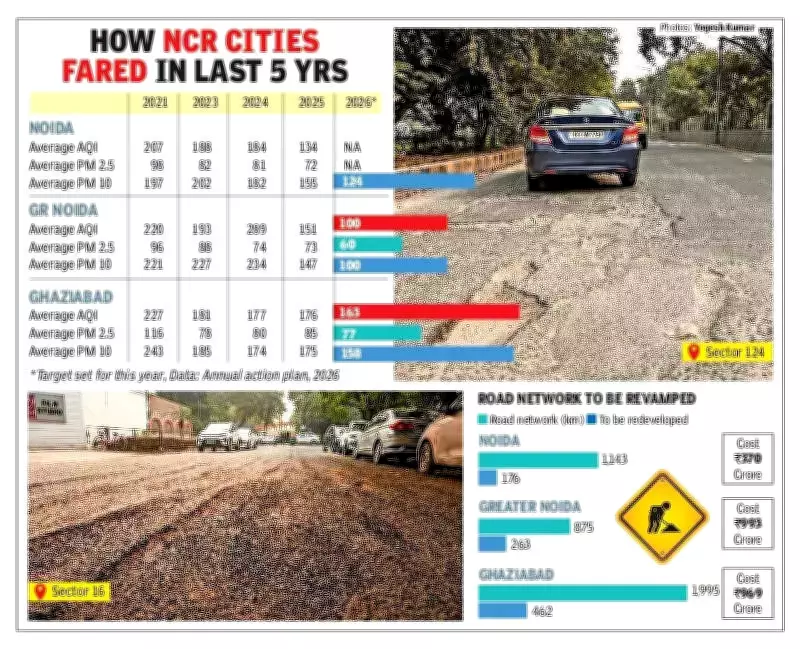
The action plan highlights a steady and commendable improvement in Noida's air quality over the past five years. The city's average AQI has shown a consistent decline, dropping from 207 in 2021 to 134 in 2025. For 2026, the state has set an ambitious PM10 target of 124 micrograms per cubic metre, a significant reduction from 155 in 2025. The plan also notes a 21% improvement in PM10 levels recorded in 2025. However, it does not specify a PM2.5 target for this year, despite annual averages remaining well above safe limits. PM2.5 levels in Noida improved from 98.9 micrograms per cubic metre in 2021 to 72.8 in 2025, but this is still far higher than the National Ambient Air Quality Standards limit of 40 and the World Health Organisation's guideline of 5.
Key pollution sources identified in Noida include 1,086 industries, 396 construction sites, and a dust-prone road network of 176 km out of a total 1,143 km. Despite this, the plan does not propose expanding the city's air quality monitoring stations beyond the existing four.

Focus on Electric Mobility and Infrastructure
With vehicular emissions remaining a primary focus, the action plan emphasizes accelerating the transition to cleaner mobility. It proposes a major scale-up of electric vehicle (EV) charging and battery-swapping infrastructure. Noida currently has 69 EV charging stations, which is 46% short of its target of 150. The plan sets a target to add the remaining 81 charging stations in phases over the year. Additionally, Noida is slated to receive its first 13 battery-swapping stations by the first quarter of 2026.
The plan also pushes for improved last-mile connectivity from metro corridors and wider deployment of mechanical road-sweeping machines. It includes initiatives for greening central verges and pavements, along with 80 training programmes for staff engaged in road dust control. However, it stops short of fixing specific targets for expanding the city's fleet of CNG and BS-VI buses, which currently stands at 188 CNG buses and 66 BS-VI buses.
Greater Noida and Ghaziabad: Specific Goals and Challenges
For Greater Noida, which has 2,340 industries and 436 construction sites, the plan reports a 34% reduction in PM10 levels in 2025 compared to the previous year. The city's average AQI improved from 220 in 2021 to 151 in 2025, with a target to bring it down to 100 in 2026. PM2.5 levels are targeted to improve from 73 in 2025 to 60 in 2026, while PM10 levels are to be reduced from 145 to 100. The state government proposes to set up two additional AQI monitoring stations by year-end, bringing the total to four. Greater Noida currently has three EV charging stations, with a goal to bridge a shortfall of 13 by 2026. A major road redevelopment project covering 263 km at an estimated cost of Rs 993 crore is also planned. Its public transport fleet includes 120 CNG buses and 20 BS-VI buses, but no electric bus rollout is specified for this year.
In Ghaziabad, covering 210 sq km, the action plan records gradual improvement with more modest targets. The city's average AQI improved from 227 in 2021 to 176 in 2025, targeting 163 in 2026. PM2.5 levels are to be reduced from 85 to 77, and PM10 from 175 to 158. Ghaziabad currently operates 50 electric buses, with plans to induct 1,100 more by 2030. It has 126 EV charging stations and aims to add 324 more, along with 20 battery-swapping stations this year.

Oversight and Public Concerns
CAQM officials have stated that while these targets are set by the state government, the commission will actively monitor and review the progress of implementation. Meanwhile, residents like Amit Gupta from Prateek Wisteria Sector 77 have raised concerns, questioning why the action plan does not address critical issues such as garbage burning, a clear roadmap for electric buses, neglect of green belts, and the utilization of National Clean Air Programme (NCAP) funds.
This annual action plan represents a concerted effort by the Uttar Pradesh government to tackle air pollution in the NCR, but its success will depend on effective execution and addressing the gaps highlighted by stakeholders.