

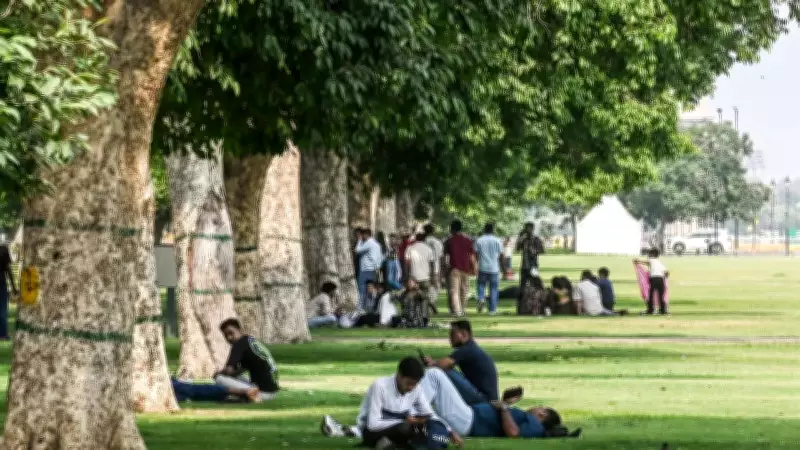
A new study has found that trees provide significant cooling in cities worldwide, countering nearly half of the urban heating caused by pavements and buildings. However, the cooling effect is weakest in poorer and hotter regions where it is most needed as global temperatures rise.
Global Cooling Average
When averaged across all the world's cities, tree cover—through shade and water vapor release—cools urban areas by an average of 0.15°C, according to the study published in Nature Communications. Without these trees, cities would warm at twice the rate due to the urban heat island effect, where dark roofs and pavement absorb heat. This human-caused warming mechanism is distinct from climate change driven by fossil fuel combustion.
Methodology and Findings
Researchers analyzed nearly 9,000 large cities by measuring temperatures in 150 city sections each. This allowed them to capture localized cooling effects, ensuring that trees in New York's Central Park, for example, were not credited for cooling more built-up areas miles away in the Bronx.

Significant populations in 31 of the larger cities already experience an average cooling from tree cover of at least 0.3°C. However, study lead author Rob McDonald, a scientist at the Nature Conservancy, noted that poorer and hotter large urban centers that need cooling most are not receiving as much relief from higher heat, which can be deadly by confusing the brain, shutting down organs, and overworking the heart.
Data Sources
The scientists used a combination of weather station measurements, satellite data, and computer models to quantify the cooling provided by trees.
Inequality in Cooling
In 20 cities, residents experience less than five-hundredths of a degree of cooling from trees. In Dakar, Senegal; Jeddah, Saudi Arabia; Kuwait City; and Amman, Jordan, tree cover is so minimal that residents essentially have no cooling from trees.
On the other end of the spectrum, McDonald examined cities where tree cover cools by at least 0.25°C. Nearly half of cities in wealthy nations achieve this level of cooling, compared to less than 10% in the poorest countries.
The list of places with the most cooling is topped by Berlin and includes Atlanta, Moscow, Seattle, Sydney, and Washington, DC—all of which have more trees. For example, Atlanta has 64% of its land area under tree canopy, McDonald said.
Reasons for Disparity
Chris Greene of the University of Dalhousie in Canada, who was not part of the study, noted that wealthy areas in North America have larger plots and residents with more political clout, contributing to larger tree cover. McDonald echoed this, stating, "There's this inequality."
Expert Perspectives
Thomas Crowther, an ecologist at the King Abdullah University of Science and Technology in Saudi Arabia, emphasized that every little bit helps. He is in a region where cities have nearly no cooling from tree cover, often due to water scarcity. "As up to 75% of the human population shifts towards living in urban environments, these buffering effects of urban vegetation are going to be vital," Crowther said.
Limitations and Recommendations
The study's authors said that cities, especially poorer and hotter ones, can and should do more to increase tree cover. However, due to limitations in water availability, land, and proper species, combined with worsening climate change, at most they would reduce future urban heating by 20%, McDonald said.
"Trees won't save us from climate change," McDonald concluded. "The climate scenarios are showing a much warmer world, and there's only so much of that that tree cover can help with."






