

US-Israel Coordinated Strikes on Iran Trigger Immediate Airspace Clearance and Flight Chaos
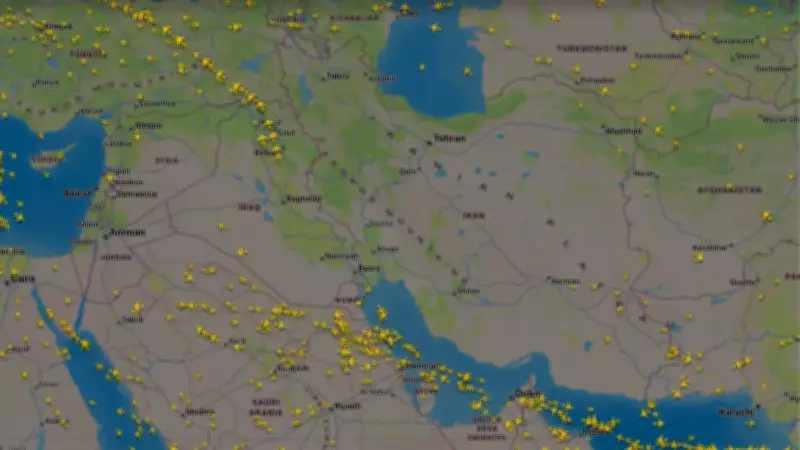
In a dramatic escalation of tensions, commercial air traffic over Iran was swiftly cleared early Saturday following coordinated military strikes by the United States and Israel. Flight tracking data vividly illustrated the unfolding crisis, showing numerous aircraft abruptly diverting away from Iranian airspace as the situation rapidly intensified.
Flight Tracking Data Reveals Mass Diversions and Empty Skies
A video shared on social media platform X by flight tracking service Flightradar24 provided compelling visual evidence of the disruption. The footage showed planes making sudden course corrections to avoid Iranian territory, resulting in large sections of the country's skies becoming nearly empty shortly after the military action commenced.
As Iranian authorities officially shut down their airspace, flight corridors over neighboring nations became congested with diverted aircraft. This created significant operational challenges for airlines and air traffic control systems across the region.

Israeli Strikes Target Multiple Locations Including Tehran
The military action involved Israeli strikes across multiple Iranian locations, including the capital city Tehran. Multiple explosions were reported in the Iranian capital, with thick plumes of smoke visible rising over various parts of the city. Residents reported hearing blasts in central districts and near government complexes, creating widespread alarm.
Israeli Defense Minister Israel Katz characterized the operation as a "pre-emptive" measure designed to "remove threats posed by Iran." He confirmed that the strikes were coordinated with United States military forces, indicating a significant level of strategic alignment between the two allies.
US President Confirms American Involvement and Issues Ultimatum
US President Donald Trump publicly confirmed American participation in the strikes, stating that the primary objective was to prevent Tehran from rebuilding its nuclear infrastructure. In a strongly worded statement, Trump issued a direct ultimatum to Iranian forces.
"To the members of the Islamic Revolutionary Guard, the armed forces, and all the police, I say tonight that you must lay down your weapons and have complete immunity, or, in the alternative, face certain death. So, lay down your arms, you will be treated fairly with total immunity, or you will face certain death," the US President declared.
Israeli Civil Defense Activated Amid Retaliation Fears
In Israel, civil defense systems were immediately activated in anticipation of potential Iranian retaliation. Air raid sirens sounded across several areas of the country, prompting authorities to urge civilians to remain near protected spaces and follow emergency protocols.
Iran Launches Retaliatory Strikes Across Middle East
Iran subsequently launched its promised retaliatory strikes, targeting both Israeli and US military facilities throughout the region. The Iranian response extended beyond these primary targets, with multiple countries including Qatar, Jordan, the United Arab Emirates, and Saudi Arabia reportedly affected by the counterstrikes.
This development significantly expanded the geographical scope of the conflict, raising concerns about broader regional instability and the potential for further escalation involving multiple Middle Eastern nations.
The coordinated nature of the initial strikes, combined with Iran's multi-front retaliation, represents one of the most serious military confrontations in the region in recent years, with immediate consequences for civilian aviation, regional security, and international diplomacy.






