Visakhapatnam's Air Quality Shows Significant Improvement After Expanded Monitoring Initiative
The Andhra Pradesh Pollution Control Board (APPCB) has taken decisive action to address air quality concerns in Visakhapatnam, expanding monitoring from a single continuous station to ten strategic locations across the city. This comprehensive approach covers industrial zones, residential neighborhoods, and commercial areas, providing a more accurate picture of the city's atmospheric conditions.
December's Alarming Air Quality Readings
In December 2025, the city faced concerning air pollution levels, with the sole continuous monitoring station recording Air Quality Index (AQI) readings above 300 for multiple consecutive days. A week-long monitoring exercise from December 15 to 21 revealed a city-wide average AQI of 187, placing Visakhapatnam in the moderate to poor air quality range.
The detailed monitoring identified several hotspots:

- Industrial Estate–Autonagar recorded a poor AQI of 217
- Police Barracks area showed a poor AQI of 223
- Gnanapuram registered a poor AQI of 240
- GVMC office at Asilmetta recorded the highest reading at 308, falling into the very poor category
Other monitored areas including Mindi, Seethammadhara, Pedagantyada, and MVP Rythu Bazaar remained in the moderate category but showed elevated particulate matter levels that warranted concern.
January Brings Measurable Improvement
When the monitoring exercise was repeated from January 19 to 25, 2026, the results showed significant improvement. The city's average AQI dropped substantially to 129, representing a notable enhancement in air quality across most monitored locations.
The comparative analysis revealed:
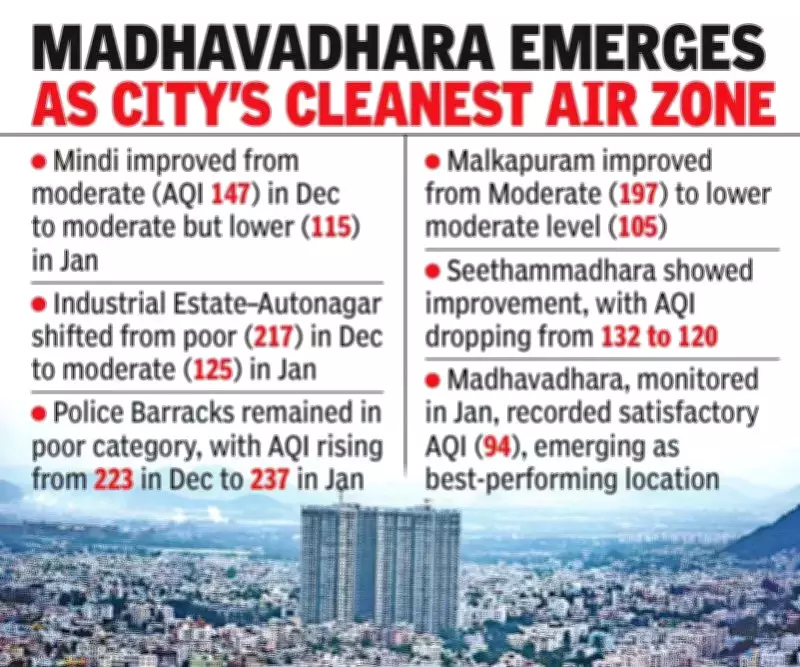
- Autonagar improved from poor (217) to moderate (125)
- Gnanapuram shifted from poor (240) to moderate (183)
- Madhavadhara emerged as the best-performing area with a satisfactory AQI of 94
- GVMC office improved from very poor (308) to moderate (197), though it remains an area requiring continued attention
One concerning exception was Police Barracks, which actually worsened from 223 to 237, remaining firmly in the poor category and highlighting the need for targeted interventions in specific locations.
Enforcement Actions Drive Improvement
Following the alarming December readings, APPCB intensified enforcement activities across Visakhapatnam. The regulatory body issued notices to multiple industries for environmental violations and imposed environmental compensation totaling approximately ₹10 crore.
The comprehensive enforcement strategy included:
- Manual and mobile monitoring of pollution sources
- E-challans for overloaded or uncovered transport vehicles
- Rigorous checks on Pollution Under Control (PUC) certificates
- Coordinated efforts with APIIC and GVMC for road sweeping and water sprinkling operations
- Inspections of fuel stations by the legal metrology department
Ongoing Monitoring and Future Plans
APPCB Environmental Engineer P Venkata Mukunda Rao confirmed that inspections continue to ensure compliance with environmental regulations. "Industries have been directed to maintain proper dust suppression systems, ensure regular road sweeping and water sprinkling within their premises, and cover raw material stacks and transported loads with tarpaulins," he stated.
Rao also noted that "rising temperatures in recent weeks have aided pollutant dispersion, thereby reducing AQI levels." However, he emphasized that regulatory actions played a crucial role in the observed improvements.
Looking forward, APPCB plans to enhance monitoring infrastructure. "As the city currently has only one continuous air quality monitoring station, we have decided to add two more stations to better assess overall AQI levels across Visakhapatnam," Rao announced, indicating a commitment to sustained environmental monitoring and protection.

The expanded monitoring network and rigorous enforcement demonstrate APPCB's proactive approach to addressing air quality challenges in one of Andhra Pradesh's major urban centers, with measurable results already visible in improved air quality readings across most monitored locations.