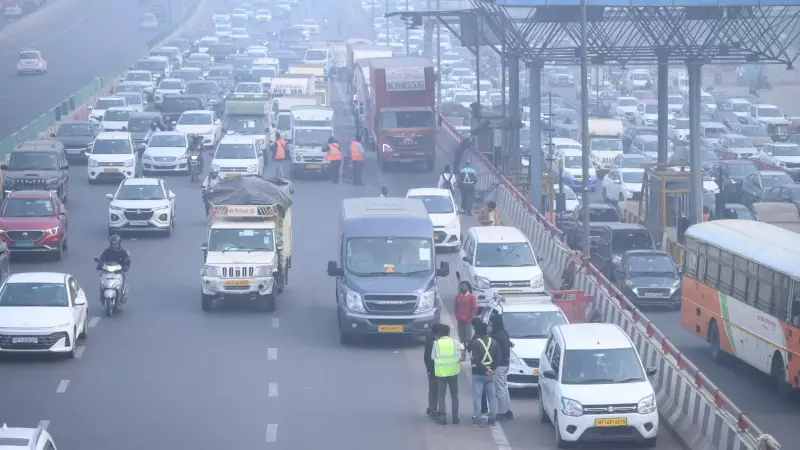
Delhi's Air Quality Crisis Extends Beyond Typical January Clearing Period
Traditionally, residents of India's capital city experience a significant improvement in air quality by the middle of January. However, this year has defied expectations, with the calendar of pollution patterns shifting by approximately ten days. The familiar winter pattern of November pollution peaks, stubble burning episodes, and fog formation all arrived earlier than usual, leaving Delhi trapped in yet another severe Air Quality Index (AQI) crisis precisely when relief typically begins.
Climate Factors and Scientific Debates
The delayed clearing of Delhi's air points toward significant environmental changes, including climate shift impacts, ENSO-neutral conditions, and an unusually wet monsoon season across North India. While scientists continue to debate causes and refine atmospheric models, Delhi's citizens found themselves once again breathing dangerously polluted air, with temporary solutions proving predictably ineffective.
During this critical period, the Supreme Court emphasized the need for precise scientific identification of emission sources before implementing mitigation strategies. In response, Delhi's apex air-quality body highlighted expert committee findings that identify vehicular emissions as the dominant primary source of PM2.5 pollution.

Long-Standing Data and Policy Disconnects
This revelation is hardly new. For more than a decade, since the launch of India's first air-quality forecasting system—the System of Air Quality Forecasting and Research (SAFAR) developed by the Ministry of Earth Sciences in 2010—emission inventories have consistently pointed to transportation as a major contributor. SAFAR's initial 2010 inventory indicated that fossil-fuel-based transport accounted for approximately 35 percent of PM2.5 emissions in Delhi. When updated in 2018, this share increased to around 40 percent.
These peer-reviewed, policy-relevant numbers have been available to decision-makers for over ten years. Equally well-established is the critical fact that PM2.5 particles, rather than larger PM10 particles, represent the genuine public health emergency. Yet policy responses frequently prioritize visible dust control through water sprinklers rather than addressing the more dangerous fine particulate matter.
The Geographic Complexity of Emission Sources
Recent reports attributing 23 percent of PM2.5 emissions to transport appear contradictory to earlier figures suggesting 40-45 percent. In reality, both statistics are technically accurate when geographic context is properly considered. The relative contribution of transport emissions changes dramatically with distance from Delhi's core.
- Within the National Capital Territory's central areas, transport contributes 40-45 percent of PM2.5 emissions
- Moving outward approximately 15-20 kilometers, transport's share decreases by about 5 percent as emissions from biofuels—including residential burning, cow dung usage, and brick kilns—become more prominent due to surrounding rural areas
- At greater distances, coal-fired power plants enter the emission inventory, sources that are absent within Delhi but significant in the wider National Capital Region
When reports fail to specify their geographic reference points, they create confusion among citizens, media, and policymakers. Percentages without spatial boundaries obscure reality rather than clarifying it.
Scientific Classification Versus Policy Needs
A second layer of confusion emerges from how emissions are categorized. Recent reports attribute 27 percent of PM2.5 to secondary particle formation. While scientifically valid, this framing proves misleading for policymaking purposes. Secondary particle formation represents an atmospheric process—the chemical transformation of gases like sulfur dioxide, nitrogen oxides, and volatile organic compounds into particulate matter—not an actual emission source.
These secondary particles exist only because primary emissions occur from natural and human-made sources at ground level. For effective mitigation, the crucial question isn't how particles form in the atmosphere, but where precursor emissions originate. When the objective is emission reduction, sources—not scientific processes—must remain the central focus of discussion.

Toward Clearer Frameworks and Effective Action
The essential question becomes what spatial framework should guide action to prevent confusion and enable effective implementation. The answer lies in adopting an airshed-based approach, as advocated in policy briefs from the National Institute of Advanced Studies (NIAS) and studies conducted under the Office of the Principal Scientific Adviser to the Government of India.
Clarity demands a two-tier framework:
- Delhi Airshed Region: A larger, multi-state domain encompassing parts of six neighboring states, relevant for scientific assessment and long-term mitigation planning
- Satellite Airshed of Delhi: The core National Capital Territory along with immediate peripheries like Noida and Gurugram, most relevant for city planners and near-term mitigation
This approach aligns with SAFAR emission inventories where transport accounts for 40 percent of emissions. Policy action must now accelerate on priorities delivering maximum impact, including:
- Faster transition to electric mobility with improvements in charging infrastructure, battery technology, recycling systems, and tire technology to address increased vehicle weight (20-30 percent)
- Reduced dependence on rare-earth materials in transportation technology
- Explicit mitigation of biofuel use and industrial emissions in surrounding rural and peri-urban areas beyond Delhi's urban core
Delhi's air crisis isn't waiting for better evidence. It suffers from blurred geographic boundaries, confusing scientific nomenclature, and the repeated use of complexity as justification for delayed action. The city awaits science-backed implementation of what we already know about pollution sources and solutions.