

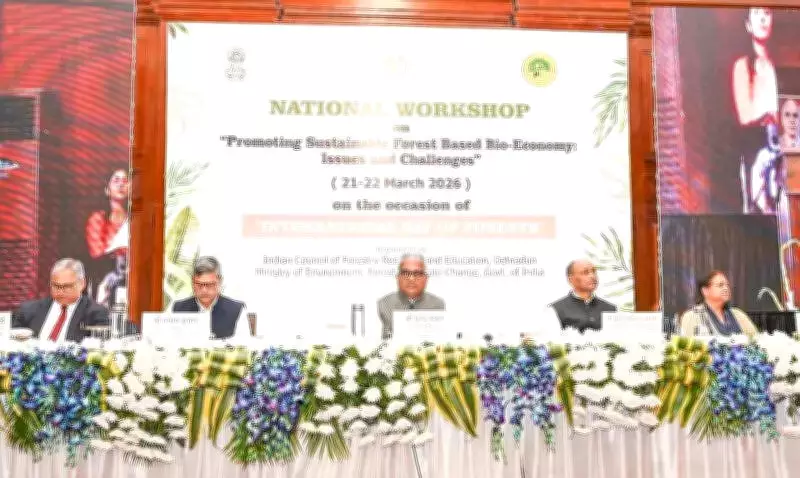
Union Minister Inaugurates Forest Bioeconomy Programme at FRI Dehradun
In Dehradun, Union Forest Minister Bhupender Yadav marked the International Day of Forests by inaugurating a two-day programme titled "Promoting Forest-based Sustainable Bioeconomy: Issues and Challenges" at the Forest Research Institute (FRI). The event, themed "Forests and Economies", was organized by the Indian Council of Forestry Research and Education (ICFRE).
Minister Emphasizes Holistic Conservation and Policy Approach
Addressing the gathering, Minister Yadav underscored that "forests are not only for economy, but also for peace". He urged foresters to adopt a spirit of trusteeship in shaping forest policies, rather than viewing them merely as regulatory frameworks. He stressed that nature is supreme and coexistence is essential for human survival, noting that conservation extends beyond tree planting to encompass the preservation of entire ecosystems.
Yadav also called for enhanced inter-departmental coordination and highlighted the significance of cultural values, carbon credits, and the Green Credit Programme (GCP) in sustaining forest resources for future generations.

Key Insights from ICFRE and MoEF&CC Officials
ICFRE Director General Kanchan Devi emphasized the critical role of bioeconomy in addressing climate change and biodiversity loss. She stated, "Forest-based bioeconomy can enable sustainable and scientific use of forest resources, promote inclusive growth, generate rural employment, and strengthen community-based development while ensuring conservation."
Sushil Kumar Awasthi, Director General of Forests and Special Secretary in the Ministry of Environment, Forest and Climate Change (MoEF&CC), pointed out that nearly 275 million people in India depend on forests. He stressed that conservation efforts must balance ecology, economy, and social justice, with development and environment being complementary rather than conflicting goals.
Community Engagement and Workshop Details
Following the inaugural session, representatives from the Himalayi Nagrik Drishti Manch, a Uttarkashi-based conservation collective, submitted a memorandum to MoEF&CC officials. They cited violations in the Bhagirathi Eco Sensitive Zone and requested an inspection by committee members to address environmental concerns.
The two-day workshop features technical sessions on a wide range of topics, including:
- Agroforestry and non-wood forest products
- Engineered wood and carbon markets
- Wildlife conservation and ecotourism
- Digital monitoring of forest resources
It brings together scientists, policymakers, industry stakeholders, and forest managers to deliberate on strengthening India's forest-based bioeconomy, identify challenges, and shape effective policy interventions for sustainable development.






