

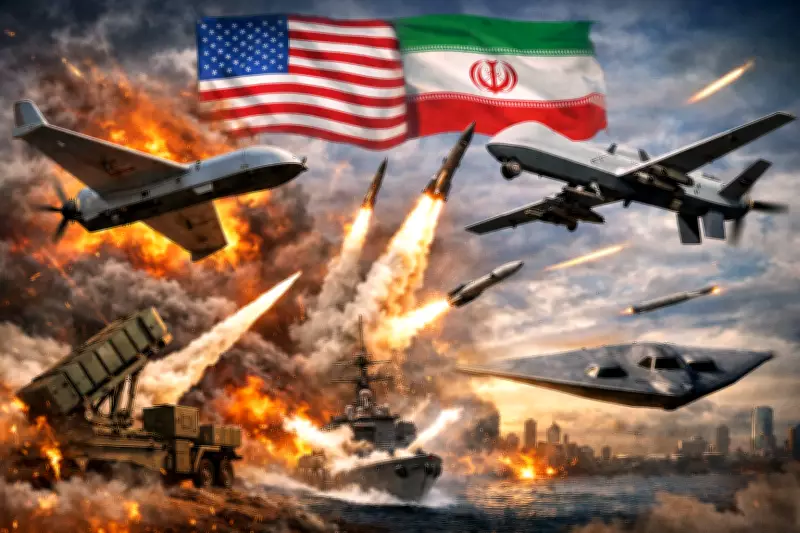
From Shahed Drones to B-2 Bombers: 10 Weapons Shaping the US-Iran War
The ongoing conflict involving the United States, Israel, and Iran has rapidly evolved into one of the most technologically advanced and economically charged missile and drone battles in modern military history. Since hostilities began on February 28, Iran has launched over 500 ballistic missiles and more than 1,000 drones across the Middle East, targeting US bases, oil infrastructure, and urban areas in the Gulf region. In response, American and Israeli forces have deployed air strikes, cruise missile attacks, and layered missile defense systems, creating a stark contrast in military strategies.
A Clash of Military and Economic Strategies
This war highlights a fundamental divide: Iran relies on low-cost, mass-produced drones and ballistic missiles designed to overwhelm defenses through sheer volume, while the United States and its allies depend on high-end technology like stealth bombers, precision-guided missiles, and expensive interception systems such as Patriot and THAAD. This dynamic has turned the conflict into a battle not only of military capability but also of economic endurance, where a drone costing tens of thousands of dollars can force defenders to fire interceptor missiles worth millions.
Shahed-136: The Drone Driving Attrition Warfare
Few weapons have shaped the current war as dramatically as Iran's Shahed-136 loitering munition. This drone, with its distinctive delta-wing design and small propeller engine, carries an explosive payload of 40 to 60 kilograms and can travel up to 2,000 kilometers. Its influence stems from its low cost, estimated between $20,000 and $50,000, and its ability to fly slowly at low altitudes, making it difficult to detect on radar.

Iran has deployed Shahed-136 drones in coordinated swarms across the Gulf, targeting military bases, oil facilities, and urban infrastructure. Even when many are intercepted, some penetrate defenses, but the real impact is economic. Destroying a cheap drone often requires a Patriot interceptor costing millions, creating a war of attrition where Iran aims to exhaust US and allied missile stockpiles by forcing unsustainable expenditures.
Shahed-131: The Swarm Multiplier
Alongside the Shahed-136, Iran uses the smaller Shahed-131 loitering munition, which carries a smaller warhead and has a shorter range of several hundred kilometers. Deployed in large numbers, it acts as a decoy in layered drone swarms, saturating radar systems and complicating interception decisions. This forces US and allied forces to adapt by using fighter aircraft and helicopters with cheaper weapons to counter low-flying threats.
Shahab-3: Iran's Long-Range Missile Backbone
While drones dominate headlines, ballistic missiles like the Shahab-3 remain crucial to Iran's long-range strike capability. With a range of about 2,000 kilometers and a warhead weighing 1,700 pounds, it can hit targets across much of the Middle East, including Israel and US military installations. Fired in coordinated waves with drone swarms, it creates complex attack profiles that challenge air defense systems, requiring multiple interception types to defend against high-speed missiles and low-altitude drones simultaneously.
Fattah Hypersonic Missile: Iran's Contested Next-Generation Weapon
Iran claims its Fattah missile represents a breakthrough, with speeds up to fifteen times the speed of sound and a range of 870 miles, capable of maneuvering during flight to make interception extremely difficult. Although US and Israeli officials have not confirmed its hypersonic capabilities, the mere possibility forces planners to reconsider the effectiveness of existing missile defense systems, adding a strategic layer to the conflict.
B-2 Spirit and GBU-57 Bunker-Buster: US Stealth and Penetration Power
On the American side, the B-2 Spirit stealth bomber and the GBU-57 Massive Ordnance Penetrator bomb carry significant strategic weight. The B-2's flying-wing design reduces its radar signature, allowing it to penetrate heavily defended airspace, while the GBU-57, weighing 30,000 pounds, is designed to destroy hardened underground facilities. In Operation Midnight Hammer, B-2 bombers reportedly used these weapons on Iranian nuclear sites, demonstrating US ability to strike deeply buried targets.

Tomahawk Cruise Missile: The Naval Strike Workhorse
The Tomahawk land-attack cruise missile, launched from US Navy destroyers and submarines, can travel over 1,500 kilometers and follow complex routes to avoid radar. Its precision guidance enables strikes on specific targets, such as bunkers or radar installations, as seen in Operation Epic Fury, allowing the US to hit Iranian targets without endangering aircraft.
LUCAS Drone: America's Answer to Shahed Swarms
To counter Iran's drone advantage, the US has adopted the Low-cost Unmanned Combat Attack System (LUCAS), a one-way attack drone modeled on the Shahed-136. Designed to be inexpensive, it allows precision strikes without relying on expensive cruise missiles, helping neutralize Iran's economic edge in drone warfare.
Patriot Missile Defense System: High-Cost Interception
The Patriot air defense system, deployed across the Middle East, has achieved interception rates exceeding 90% against incoming missiles and drones. However, each PAC-3 interceptor costs about $4 million, creating an economic imbalance when used against cheap drones and raising concerns about sustainability as attacks continue.
THAAD: High-Altitude Missile Defense
The Terminal High Altitude Area Defense (THAAD) system intercepts ballistic missiles during their final descent at high speeds, operating at higher altitudes than Patriot. Despite its effectiveness, THAAD interceptors cost around $12 million each, and previous engagements have shown that high-volume attacks can quickly deplete inventories, questioning long-term sustainability.
APKWS: The Cheaper Solution to Drone Swarms
To address cost imbalances, the US uses the Advanced Precision Kill Weapon System (APKWS), which converts a Hydra rocket into a laser-guided weapon costing about $25,000. Fired from aircraft, it provides a cheaper method to destroy drones compared to Patriot interceptors, helping conserve expensive missile stockpiles.
The Real Battlefield: Endurance and Economics
Ultimately, this war illustrates a broader shift in modern warfare, where economic endurance may outweigh technological superiority. Iran's strategy of mass-producing inexpensive weapons aims to exhaust US defenses, while the US relies on advanced but costly systems. The outcome may hinge on which side can sustain its weapons supply longer, making the conflict a test of both military and economic resilience in the Middle East.





