

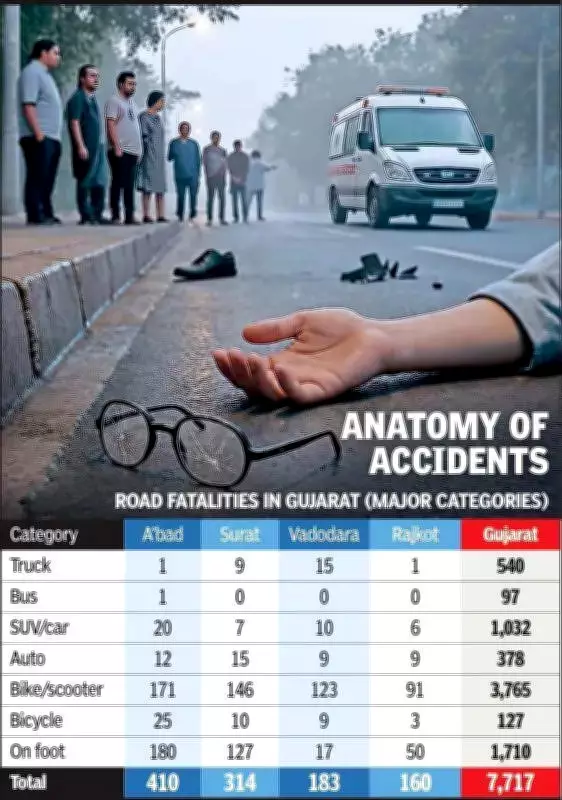
Ahmedabad recorded the highest number of road fatalities among 53 cities in India in 2024, according to the National Crime Records Bureau (NCRB) report 'Accidental Deaths and Suicides in India' (ADSI) released on Wednesday. The city reported 410 road deaths, of which 205 (50%) were pedestrians (180) and cyclists (25). This proportion is more than double the national average of 21% for these two vulnerable categories combined.
Comparison with other major cities
The report highlights that the share of pedestrian and cyclist fatalities in Ahmedabad is significantly higher than in other major cities. In Chennai, these categories accounted for 37% of road deaths, followed by Bengaluru (29%), Kolkata (25%), Mumbai (11%), and Delhi (8%). Among other Gujarat cities, Rajkot recorded 33% and Surat 44%, both above the national average, while Vadodara was lower at 14%.
Other major causes of road fatalities in Ahmedabad
Two-wheelers were involved in 171 deaths (42%), and SUVs or cars accounted for 20 deaths (5%). Despite the high numbers, there was a silver lining: overall road fatalities in Ahmedabad decreased from 535 in 2023 to 410 in 2024.

State-level trends in Gujarat
The pattern for Gujarat as a whole differed slightly. Out of 7,717 fatal road accidents, two-wheelers accounted for 3,765 deaths (49%). Pedestrians followed with 1,710 deaths (22%), SUVs/cars with 1,032 (13%), and trucks with 540 (7%).
Expert insights on pedestrian and cyclist safety
Amit Khatri, a road safety expert based in Ahmedabad, emphasized that pedestrians and cyclists are vulnerable road users, especially in urban areas. He cited several reasons for the high fatalities: insufficient foot overbridges, inadequate usable footpaths, and infrastructure that does not promote walking. To reduce deaths, he suggested clear demarcation of crowded areas such as vegetable markets, creation of vehicle-free zones, and installation of walker-friendly markings and infrastructure.
Experts also urged authorities to conduct better analysis of fatal road accidents to identify specific causes and implement targeted interventions.






