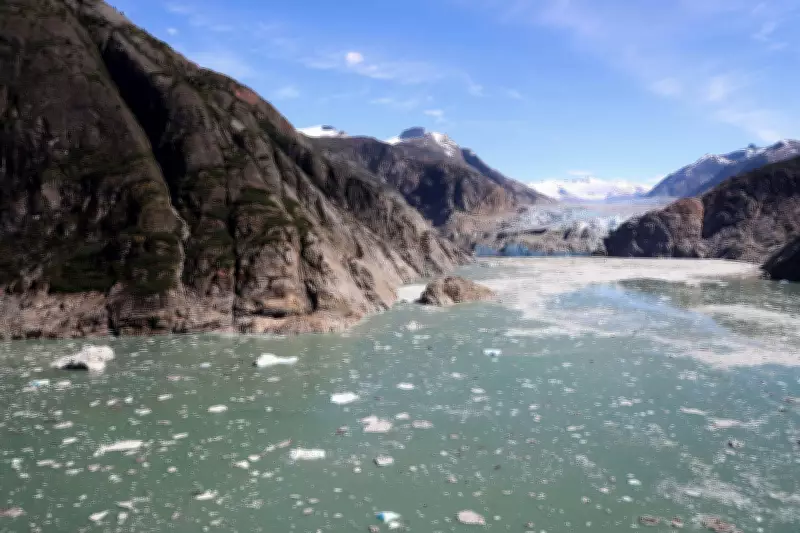
Each summer, many tourists travel by cruise ship or smaller tour boat to Alaska’s wild shores and scenic fjords. The voyage into the fjords near Juneau can be a once-in-a-lifetime chance to see glaciers and mountain ranges. Tourists often crowd the railings to photograph icebergs drifting through the bright blue waters of glacial valleys. They might assume the surrounding mountains make the ground as stable as the scenery is beautiful. But climate-driven glacier retreat is exposing a serious underlying instability in this popular landscape.
In recent years, rising global temperatures have caused huge ice formations to melt and retreat at an alarming rate across the polar regions. For millennia, thick layers of ice pressed against the valley walls, acting as a retaining wall for the debris above them. As the glaciers retreat, they leave behind dangerously over-steepened slopes that are no longer supported by protective ice. This process leaves behind a hidden hazard that can turn a stable-looking slope into a sudden danger.
A Colossal Mountainside Collapse Triggers a Massive Wave
To assess the scale of the threat, an international team of earth scientists studied the geological event. According to a study published in the journal Science under the title “A 481-meter-high landslide-tsunami in a cruise ship-frequented Alaska fjord,” lead author Dan Shugar and a global team analysed a massive slope failure that occurred in Tracy Arm Fjord. Early on August 10, 2025, an enormous mass of rock totalling more than 64 million cubic meters gave way completely, collapsing down the mountainside right beside the retreating South Sawyer Glacier.

The effect caused by such a large amount of rock smashing into the restricted area of the fjord’s water could be best described as incredible. According to the Science study, the first collapse resulted in a tsunami breaking wave of one hundred meters high, travelling through the water at a speed surpassing seventy meters per second. During this process, an incredible amount of water surged forward, crashing against the other shore and climbing the sheer mountain slope to reach an incredible run-up altitude of four hundred and eighty-one meters. It is estimated that the run-up is among the tallest tsunami run-ups recorded in modern times, devastating mature forest within its reach and leaving a lasting mark on the terrain. This event highlights risks for adventure travel. Authorities must now map fragile slopes and manage visitor access to ensure future safety in these changing landscapes.
An Extremely Close Shave for Maritime Tourism
The event is a reminder of the risks climate-driven slope failures can pose to adventure travel. As highlighted in a University of Calgary report titled “Tracy Arm fjord tsunami in popular Alaskan cruise spot provides valuable lessons,” the lack of casualties or destroyed vessels during this catastrophic surge was almost entirely a matter of incredibly lucky timing. Because the mountainside collapsed early in the morning, the daily fleet of commercial cruise ships, local sightseeing vessels, and wilderness kayakers had not yet entered the fjord. Had the failure occurred later in the day, when many sightseers are typically on the water below the glacier, the human toll could have been far greater.
Addressing the near miss will require a careful review of public safety and cruise-ship operations in rapidly changing glacier landscapes. The data suggest that monitoring systems detected increasing seismic activity days before the collapse, but pinpointing the exact time of failure was unlikely. For tour operators and local governments, the incident is a warning about the changes underway in the area. Safety for future travellers will depend on mapping fragile slopes and managing visitor access carefully in vulnerable areas.