

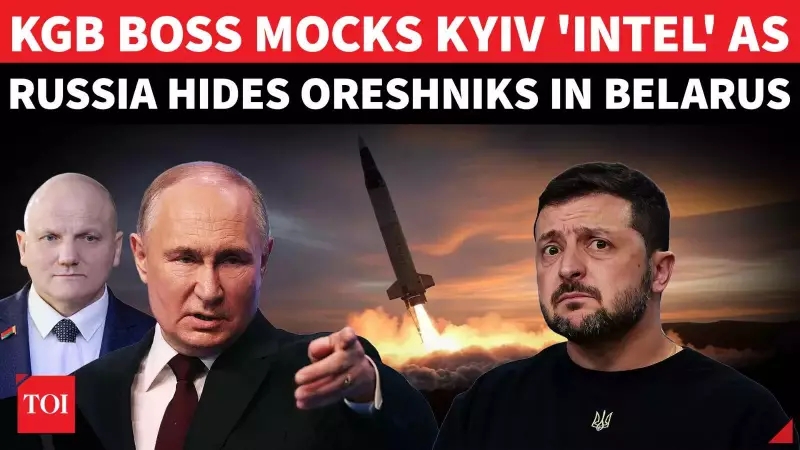
A fresh intelligence clash has erupted in Eastern Europe, centering on the secretive deployment of Russia's advanced Oreshnik hypersonic missiles. The controversy began after Ukrainian President Volodymyr Zelensky asserted that Kyiv possesses detailed knowledge of the weapons' locations, including those stationed within the territory of ally Belarus.
Belarusian Intelligence Chief Dismisses Kyiv's Claims
Minsk responded with swift and sharp dismissal to President Zelensky's statements. The head of Belarus's intelligence agency, often referred to as the KGB chief, openly mocked the Ukrainian leader's assertions. He insisted that the deployment sites for such strategic weapons remain among the state's most closely guarded secrets, casting doubt on the validity of Kyiv's purported intelligence.
This public spat, which unfolded on December 25, 2025, underscores a deepening shadow war that runs parallel to the ongoing military conflict in Ukraine. This hidden battlefield is increasingly defined by espionage accusations, aggressive counterintelligence operations, and rising anxieties over potential cross-border sabotage activities.

Hypersonic Weapons Edge Closer to NATO's Border
The core of the dispute—the Oreshnik missiles—represents a significant escalation in military posture. The potential basing of these hypersonic systems in Belarus places them dramatically closer to the eastern frontier of the NATO alliance. This geographical shift transforms the region's security calculus, raising stakes for all involved parties.
As these high-speed, hard-to-intercept weapons are positioned near the alliance's flank, the role of secrecy and information control has become paramount. The battle over what is known, what is claimed, and what is hidden is now a critical front itself, actively shaping the precarious security environment across Europe.
Intelligence Warfare Takes Centre Stage
The exchange between Kyiv and Minsk highlights how intelligence warfare has moved from the shadows to the forefront of geopolitical confrontation. The public mocking by the Belarusian spymaster is not merely a denial but a tactical move in this psychological and informational conflict, aimed at undermining the credibility of Ukrainian intelligence.
This incident confirms that beyond the artillery duels and trench warfare, a complex struggle for information superiority is in full swing. The outcome of this clandestine battle could influence strategic decisions, diplomatic maneuvers, and the overall trajectory of the wider conflict, making it a pivotal element of Europe's ongoing security crisis.






