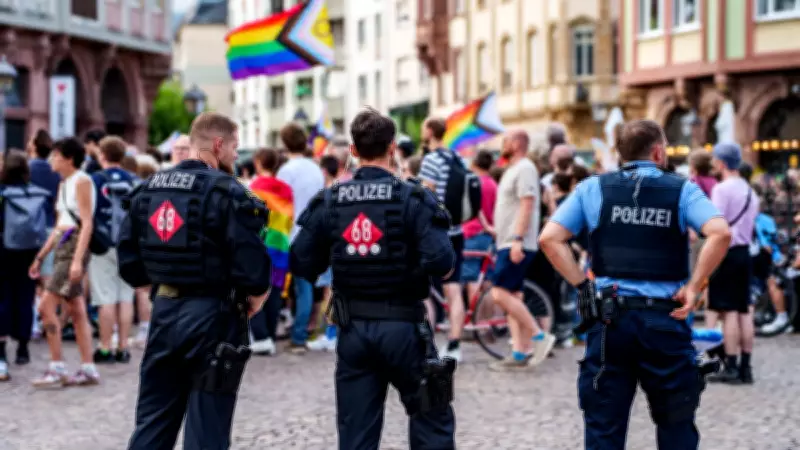
German authorities have classified the attack at Berlin's Pride parade as a suspected Islamic terrorist incident, triggering a massive manhunt for the lone assailant who remains at large. The attack, which occurred on July 25, 2026, along the parade route in central Berlin, left 15 people injured, three of them critically. Federal Interior Minister Nancy Faeser confirmed the terrorism assessment in a press conference on July 26, stating that evidence points to an Islamist extremist motive.
The Attack Unfolds
Around 4:30 p.m. local time, the suspect drove a rented van into a crowd of parade participants near the Brandenburg Gate. Witnesses reported that the vehicle accelerated suddenly before crashing into barriers and pedestrians. Police confirmed that the driver then fled on foot, abandoning the van. Eyewitness accounts and security footage helped authorities piece together the sequence: the van bore no license plates and had been rented under a false identity three days prior.
Emergency services quickly arrived, treating the injured at the scene and transporting them to nearby hospitals. The injured include individuals from Germany, France, and Italy. Berlin police have set up a special task force of 200 officers dedicated to locating the suspect, who is believed to be a 27-year-old German citizen of Syrian descent named Ahmed al-Masri. Officials have not yet confirmed his exact location but suspect he may have fled to the Netherlands or Belgium.

Government Response and Security Measures
Interior Minister Faeser condemned the attack, saying: "This was a targeted act of terrorism against our democratic values. We will use all means necessary to bring the perpetrator to justice and ensure the safety of our citizens." She also announced increased security at all public events across the country, including the deployment of additional police and intelligence personnel. Chancellor Olaf Scholz expressed solidarity with the victims and their families, vowing that Germany would not be intimidated by extremists.
The attack has prompted a review of security protocols for large public gatherings. Berlin police chief Barbara Slowik announced that all future Pride events will have vehicle barriers and expanded surveillance. The incident has also reignited debates about immigration and integration policies in Germany, with some politicians calling for stricter deportation laws for individuals with terrorist ties.
International Reactions and Support
Leaders from around the world have expressed shock and solidarity. French President Emmanuel Macron offered France's full support in the investigation, while United States President Kamala Harris condemned the act as "an attack on the universal spirit of Pride." The European Union pledged to enhance counterterrorism cooperation among member states. In Berlin, vigils were held on the evening of July 26, with thousands gathering at the attack site, holding rainbow flags and candles.
The attack has also drawn attention to the rise of Islamist extremism in Europe. According to the Federal Criminal Police Office (BKA), Germany has faced 37 Islamist-motivated attacks or plots since 2020, with the number increasing by 15% in the past year. The suspect, Ahmed al-Masri, was previously known to authorities for minor offenses but was not on a watchlist for terrorism.
Investigation and Ongoing Manhunt
Police have released a photo of al-Masri and urged the public to report any sightings. The investigation has involved raids on four locations in Berlin and two in Lower Saxony, where documents and electronic devices were seized. Authorities are also examining the suspect's online activity, which reportedly included radical content. A potential accomplice is being sought, but no arrests have been made yet. The manhunt extends across multiple borders, with Europol assisting in tracing the suspect's movements.

Dr. Karsten Müller, a terrorism expert at the German Institute for International and Security Affairs, noted: "The attack demonstrates the ongoing threat from lone actors inspired by online propaganda. The fact that the suspect evaded detection highlights gaps in surveillance." Meanwhile, community leaders have emphasized that the attack should not stigmatize the entire Muslim community. Imam Sami al-Rashid of Berlin's Al-Taqwa Mosque condemned the violence, stating: "This cowardly act has no place in Islam. We stand with the LGBTQ+ community in grief and defiance."
Impact on Pride Events and Civil Society
The attack has cast a shadow over Pride celebrations worldwide. Organizers of upcoming Pride events in Munich, Cologne, and Hamburg have announced enhanced security measures. Berlin's Pride, which annually draws over a million participants, had already implemented strict security protocols, but this incident has prompted a reassessment. Many attendees expressed defiance, vowing to continue the march in solidarity. A survivor, Maria Schmidt, told local media: "We will not let fear win. Love is stronger than hate."
The attack has also sparked discussions about the need for better integration of refugees and more robust counter-radicalization programs. Germany has invested heavily in such initiatives since the 2016 Berlin Christmas market attack, but experts argue that more needs to be done at the grassroots level. As the manhunt continues, German society remains on edge, but united in its resolve against terrorism.