

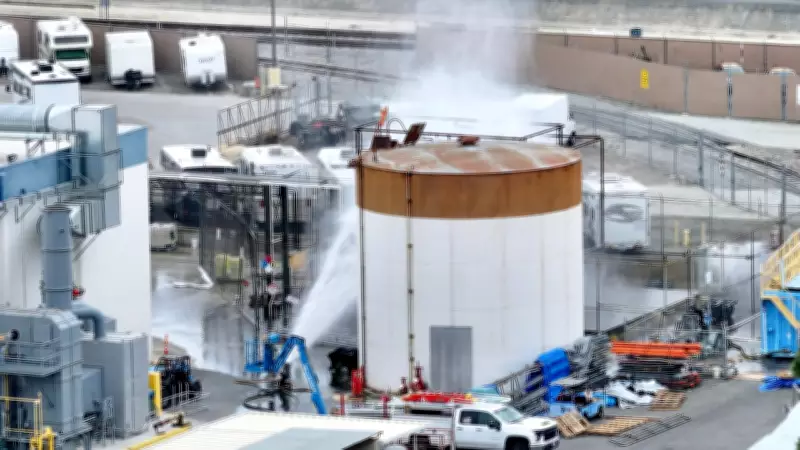
A significant chemical emergency unfolded in Garden Grove, Orange County, California, prompting the evacuation of approximately 40,000 residents after a storage tank at the GKN Aerospace facility began overheating and releasing hazardous vapors. The tank contains methyl methacrylate (MMA), a volatile industrial liquid commonly used in the production of plastics and resins. Officials have warned that the unstable tank could potentially fail, leading to a major spill or even an explosion, which necessitated large-scale evacuation orders across several nearby cities.
Details of the Incident
The incident began on Thursday at the GKN Aerospace facility in Garden Grove, where a storage tank containing methyl methacrylate overheated and started venting vapors. As the situation escalated, evacuation orders were issued and later expanded to cover parts of Garden Grove, Anaheim, Stanton, Cypress, Buena Park, and Westminster. Emergency crews have been working tirelessly to cool the tank and mitigate risks while ensuring public safety.
What is Methyl Methacrylate?
Methyl methacrylate (MMA) is a colorless industrial chemical used to manufacture acrylic plastics, resins, and coatings. It is commonly found in products such as acrylic glass, aircraft windows, paints, adhesives, dental materials, and lightweight plastic components. The chemical has a strong fruity odor and evaporates easily, which means it can quickly release vapors during a leak or accident.

MMA is considered hazardous because it is highly flammable, and its vapors can ignite when exposed to heat, sparks, or flames. In large storage tanks, the chemical must be carefully stabilized and temperature-controlled, as overheating can increase pressure inside the container and raise the risk of fire or explosion. Health agencies, including the U.S. Environmental Protection Agency and the CDC, warn that exposure to MMA vapors can irritate the eyes, skin, nose, and throat. Higher levels of exposure may cause headaches, dizziness, nausea, coughing, and breathing difficulties. Because the vapors are heavier than air, they can spread along the ground and travel toward ignition sources.
Concerns Over Polymerization
Another major concern is MMA's polymerization risk, where the chemical can begin reacting with itself and generate heat. If that reaction accelerates uncontrollably, it can trigger thermal runaway, a dangerous process in which rising heat causes the reaction to speed up even further, rapidly building temperature and pressure inside the tank. In severe cases, this can cause a rupture, fire, or explosion. That is why emergency crews in California have been continuously cooling the damaged storage tank to prevent the situation from escalating.
Why Officials Were So Concerned
The fear was not just that the tank could leak. Emergency officials warned it could also rupture or enter thermal runaway, a dangerous chain reaction in which heat and pressure keep building until the container fails. Reuters reported that the tank held about 7,000 gallons of MMA, while other reports indicated multiple tanks were present at the site, with several already neutralized, leaving one unstable tank as the primary concern. Because the chemical is flammable and can give off hazardous vapors, even a partial failure could put nearby neighborhoods at risk.
Response Efforts
Fire crews have been using remotely operated water hoses to cool the tank and reduce its temperature, while also placing sandbag barriers to prevent any spill from reaching storm drains or nearby waterways. Officials have also brought in hazardous-material experts to help determine the safest long-term fix. According to the latest reports, the tank's temperature had stabilized, but crews were still treating the situation as dangerous enough to keep evacuation orders in place.
What Residents Were Told
Health officials warned that exposure to methyl methacrylate vapors could cause respiratory problems and nausea, which is why residents in the evacuation zone were told to leave quickly and stay clear until officials gave the all-clear. Reuters reported that around 15% of ordered evacuees had not left, even as shelters were opened in nearby cities. The broader message from authorities was simple: the tank remained unstable, and the safest move was to keep people away until the risk had been reduced.

About the Author
The TOI Science Desk is an inquisitive team of journalists, ceaselessly delving into the realms of discovery to curate a captivating collection of news, features, and articles from the vast and ever-evolving world of science for the readers of The Times of India. They serve as a scientific companion, delivering a daily dose of wonder and enlightenment. Whether it's the intricacies of genetic engineering, the marvels of space exploration, or the latest in artificial intelligence, the TOI Science Desk ensures readers stay connected to the pulse of the scientific world. They are not just reporters but storytellers of scientific narratives, committed to demystifying the intricacies of science and making it accessible and engaging for readers of all backgrounds.





