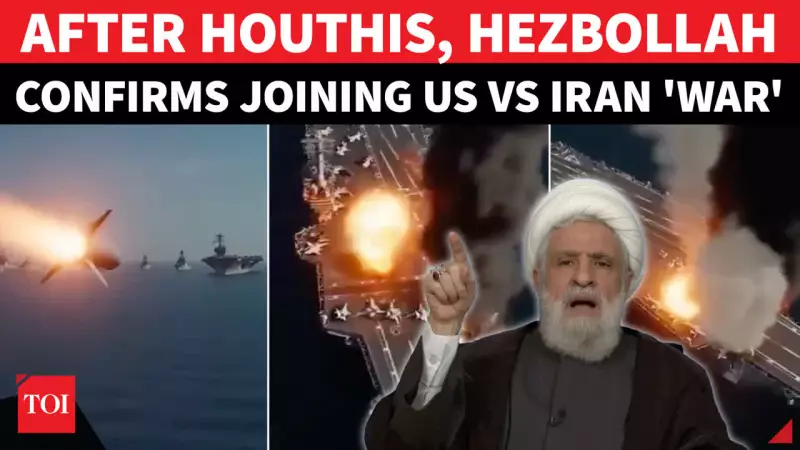
Hezbollah Leader Issues Stark Warning: Group Will Defend Iran Against Any US Attack
In a dramatic escalation of Middle East tensions, Hezbollah Secretary General Naim Qassem has declared that his militant group would actively fight alongside Iran if the Islamic Republic comes under attack from the United States. The warning came during a solidarity rally in Lebanon, where Qassem explicitly stated that any assault on Tehran would be considered an attack on Hezbollah itself, effectively linking their fates in the volatile regional power struggle.
Regional Conflict Fears Intensify as Rhetoric Hardens
Qassem's remarks represent a significant hardening of Hezbollah's position, with the leader warning that a new war targeting Iran would ignite the entire Middle East region. This declaration comes amid heightened military posturing from Washington, which has recently deployed the USS Abraham Lincoln carrier strike group to the Gulf waters. The deployment signals America's continued military readiness in the region, even as diplomatic channels remain strained.
US Military Buildup and Trump's Stance on Iran
The United States has significantly bolstered its military presence in the strategic Gulf region, with the USS Abraham Lincoln's deployment representing a clear show of force. President Donald Trump has repeatedly emphasized that military action against Iran remains a viable option on the table, maintaining pressure on Tehran through both economic sanctions and strategic military positioning. This combination of economic pressure and military readiness has created what analysts describe as a tinderbox situation in the Middle East.

Hezbollah's Strategic Alignment with Tehran
Hezbollah's open declaration of solidarity with Iran marks a crucial development in Middle Eastern geopolitics. The Lebanese militant group, which has long received substantial support from Tehran, is now formally declaring that:
- Their security interests are directly tied to Iran's survival
- They will not maintain neutrality in any US-Iran confrontation
- Their military capabilities would be deployed in Iran's defense
- The consequences would extend far beyond Iran's borders
Broader Regional Implications and Conflict Risks
The situation has created what security experts describe as a perfect storm of regional tensions. With Hezbollah openly aligning its military fate with Tehran, and Washington maintaining its aggressive posture toward Iran, the Middle East finds itself once again standing on the brink of a much wider conflict. The involvement of proxy groups, regional powers, and international actors creates a complex web of potential escalation points that could rapidly expand any limited confrontation into a broader regional war.
As military assets continue to concentrate in the Gulf region and rhetoric intensifies on all sides, diplomatic efforts face increasing challenges in preventing what many fear could become the most significant Middle East conflict in decades. The international community watches with growing concern as these developments unfold, recognizing that the stakes extend far beyond the immediate regional players to potentially impact global energy markets and international security architecture.