

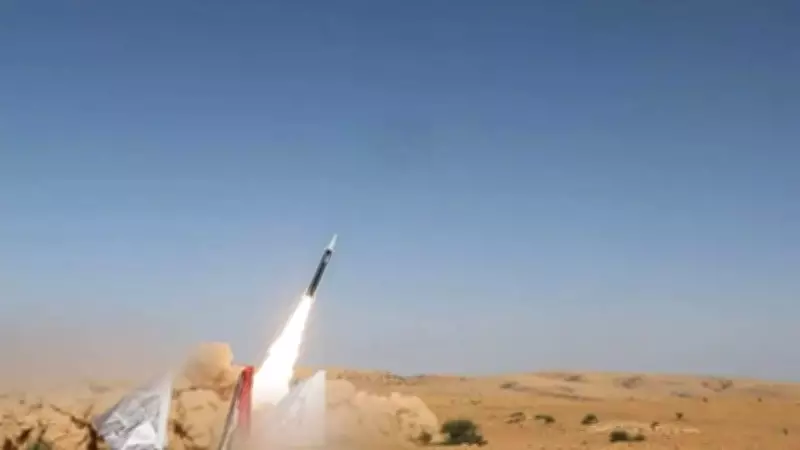
Houthis Escalate Conflict with Hypersonic Missile Strike on Israel
In a significant escalation of the Middle East conflict, Yemen's Houthi group has claimed responsibility for firing a "Palestine 2 hypersonic ballistic missile" at Israel. This attack directly challenges the effectiveness of Israel's advanced air defense systems, including the Iron Dome and Arrow networks, raising alarms over regional security dynamics.
Details of the Missile Launch and Houthi Claims
The Iran-backed Houthi group announced that the Palestine 2 missile, equipped with multiple warheads, was targeted towards the Tel Aviv area. According to their statement, this strike was a retaliatory measure against what they described as "crimes of genocide and dangerous escalation" by Israel in the Gaza Strip. The group emphasized their commitment to continuing such actions until the aggression against Gaza ceases, framing it as a fulfillment of religious, moral, and humanitarian duties.
Israel's military confirmed the missile launch, reporting that air defense systems were activated in response. In an official statement, they noted, "Following the sirens that sounded a short while ago in several areas of Israel, a missile launched from Yemen was intercepted." This incident marks the Houthis' direct involvement in the broader regional conflict, with the group also claiming to have used a "batch of ballistic missiles" to target sensitive military sites in Israel.

Advanced Technology of the Palestine 2 Missile
The Palestine 2 missile is believed to be based on sophisticated Iranian designs and is characterized as a hypersonic weapon capable of reaching speeds up to Mach 16. Unlike conventional ballistic missiles that follow predictable arcs, this system utilizes a hypersonic glide vehicle that can manoeuvre mid-flight and alter its trajectory unpredictably.
This manoeuvrability is key to how such missiles pose a threat to layered defense systems like Iron Dome, David's Sling, and Arrow. These Israeli systems are engineered to track and intercept threats based on anticipated flight paths. However, a missile that zigzags at high speeds or employs a "skip trajectory" along the atmosphere's edge complicates radar tracking and reduces interception timing accuracy.
Reports indicate that the Palestine 2 travels through the upper atmosphere before deploying a glide vehicle that re-enters and manoeuvres erratically. This approach minimizes reaction time for interceptors and may enable the missile to exploit gaps in radar coverage, especially if it operates at variable or lower altitudes.
Challenges to Israel's Multi-Layered Defense
Israel relies on a multi-tiered defense strategy: Arrow systems for long-range threats, David's Sling for medium-range, and Iron Dome for short-range rockets. Despite this robust setup, systems like Iron Dome are not designed to counter hypersonic or highly manoeuvrable ballistic missiles. Even higher-tier systems face difficulties when targets deviate from predicted trajectories, highlighting vulnerabilities in current defense mechanisms.
Broader Implications for Regional and Global Security
This strike underscores a worrying trend in modern warfare, where non-state actors are deploying advanced missile technology once reserved for major military powers. The Houthis stated that their operation was coordinated with Iran and Hezbollah, indicating deeper regional alignment and potential for further escalations.
The escalation occurs amidst ongoing Israeli strikes on Yemen, including reported attacks involving 20 fighter jets targeting command centres and weapons depots. Additionally, the Houthis' growing missile capabilities raise concerns for global trade, particularly in critical routes like the Red Sea and Bab el-Mandeb strait, where previous Houthi attacks have disrupted shipping.
With tensions rising, the use of advanced missiles like the Palestine 2 signals a new phase in the conflict, combining speed, manoeuvrability, and strategic reach. This development not only impacts regional stability but also poses challenges for international security and defense strategies worldwide.






