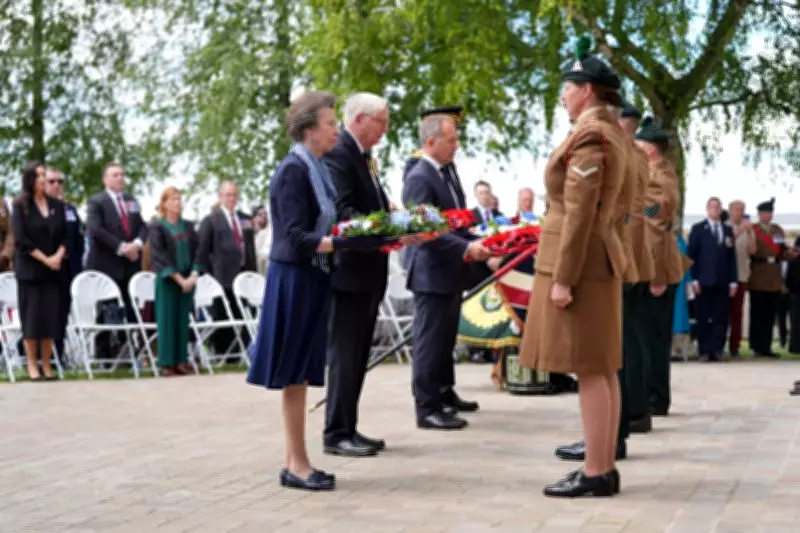
Princess Anne, the only sister of King Charles III, commemorated the 110th anniversary of the Battle of the Somme in France earlier this month, honoring Indian troops who played a vital but often overlooked role in the deadliest campaign of World War I.
Indian Cavalry at the Somme
The 2nd Lancers (Gardner's Horse), the only Indian Army unit to produce three Army Chiefs—including the incumbent General Dhiraj Seth—was among the Indian cavalry regiments that fought at the Somme. The 9 Horse (Deccan Horse) also participated. Both units are among the Indian Army's oldest and most decorated armoured units, tracing their origins to 1809 and 1790 respectively as part of the Presidency Armies. They were awarded the Battle Honour Somme for their performance.
The Battle of the Somme, also known as the Somme Offensive, was fought from July 1 to November 18, 1916, along the upper reaches of the Somme River in France. It pitted the British Empire and French Republic against the German Empire. Historical records state the battle was intended to hasten victory for the Allies. More than three million men fought, with over a million killed or wounded, making it one of the deadliest battles in human history.

Princess Anne and Commonwealth War Graves
Princess Anne, president of the Commonwealth War Graves Commission (CWGC), and The Duke of Gloucester joined commemorations at events across the Somme, including at the Thiepval Memorial, the largest CWGC memorial by number of casualties commemorated. The CWGC maintains graves and memorials of nearly two million soldiers from Commonwealth countries who died in the World Wars.
According to the CWGC website, the first day of the Somme Offensive, July 1, 1916, remains the single deadliest day in British military history, with over 57,000 casualties suffered by the British Army. The website states: "The Battle of the Somme was a major moment not just for Britain and Ireland, but for the wider Commonwealth. Australian, Canadian, Indian, New Zealand, Newfoundland and South African forces were all part of the battle."
Indian Soldiers in WWI
During World War I, more than 140,000 Indian soldiers served in Europe with valor from 1914 to 1918, including 90,000 infantry and cavalry personnel and 50,000 non-combatant support staff. Frontline casualties were estimated at nearly 84,000. After 1915, Indian infantry divisions were redeployed to Mesopotamia, leaving only two cavalry formations—the 1st and 2nd Indian Cavalry Divisions—in France, where they fought dismounted in the trenches.
The Embassy of India in France lists the 2nd Lancers and 9 Horse as participants in the Battle of the Somme, where they fought at Bazentin Ridge and High Wood. Gardner's Horse is associated with two other Army Chiefs: General Rajendrasinhji Jadeja commanded the regiment, and General Bipin C Joshi, like General Seth, was commissioned into it. Another Army Chief, General A S Vaidya, commanded the Deccan Horse.
Notable Cavalry Charge
The Imperial War Museum (IWM) in London mentions Indian cavalry charging and attacking German machine-gun positions. The most notable action occurred on July 14, 1916, during the attack on Bazentin Ridge. The Deccan Horse and the British 7th Dragoon Guards were ordered to move forward in the afternoon. According to IWM records: "Emerging from Carnoy Valley, they galloped towards positions between High Wood and Delville Wood. The charge was bold but costly. German resistance was fierce and the cavalry achieved limited gains before withdrawing. As many as 74 men and 110 horses of the Deccan Horse and supporting units were killed or wounded in that engagement alone."