

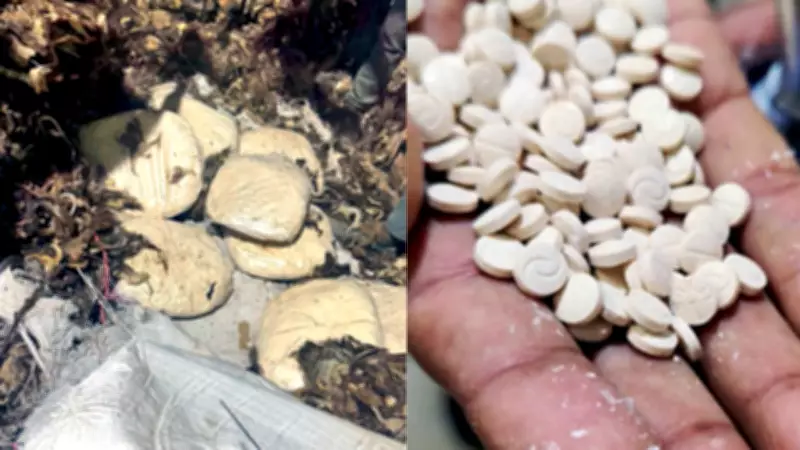
In a landmark operation, the Narcotics Control Bureau (NCB) has dismantled a major international drug trafficking network and made India's first-ever seizure of captagon, a highly addictive psychotropic substance. This drug, known as the 'jihadi drug,' is reportedly used by Islamic State operatives in West Asia. The seizure included 227.7 kilograms of captagon tablets and powder, valued at approximately Rs 182 crore, leading to the arrest of Syrian national Alabras Ahmad.
Details of the Seizure
Captagon primarily contains fenethylline and amphetamine and is heavily regulated under the Narcotic Drugs and Psychotropic Substances Act. Union Home Minister Amit Shah praised the operation on social media platform X, calling it a "shining example" of the government's zero-tolerance policy towards drugs. He reiterated the commitment to clamp down on every gram of drugs entering or transiting through India.
Breakthrough in Delhi
The operation began on May 11 in Delhi, following actionable intelligence from a foreign drug law enforcement agency indicating that India was being used as a transit zone. NCB officials raided a rented residential property in south Delhi's Neb Sarai, recovering 31.5 kilograms of captagon tablets. The contraband was meticulously concealed inside a commercial chapati-cutting machine, which was intended for export to Jeddah, Saudi Arabia. Ahmad, who managed logistics, had rented the hideout and entered India on a tourist visa in November 2024, which expired in January 2025.

Extension to Gujarat
Following Ahmad's interrogation, the operation expanded to Gujarat. On May 14, NCB intercepted a suspicious cargo container at Mundra port. The container, shipped from Syria with a declared consignment of sheep wool, was found to contain three hidden bags with 196.2 kilograms of high-grade captagon powder. Investigators determined that the consignment was intended for transshipment to Gulf region markets, where captagon abuse has caused severe law enforcement and public health crises.
Broader Implications
The operation highlights the importance of international intelligence-sharing and multi-jurisdictional cooperation in intercepting global drug cartels. It also points to an alarming trend of syndicates exploiting commercial maritime cargo routes, similar to a recent seizure in Mumbai of 349 kilograms of cocaine from Ecuador hidden in a shipping container. The NCB has launched a wider probe into the syndicate's procurement sources, financial and hawala networks, and global handlers.
The seized captagon pills feature a logo of two overlapping crescent moons, leading to the Arabic street slang 'Abu Hilalain' (father of the two crescents). This operation marks a significant step in combating drug trafficking in India.






