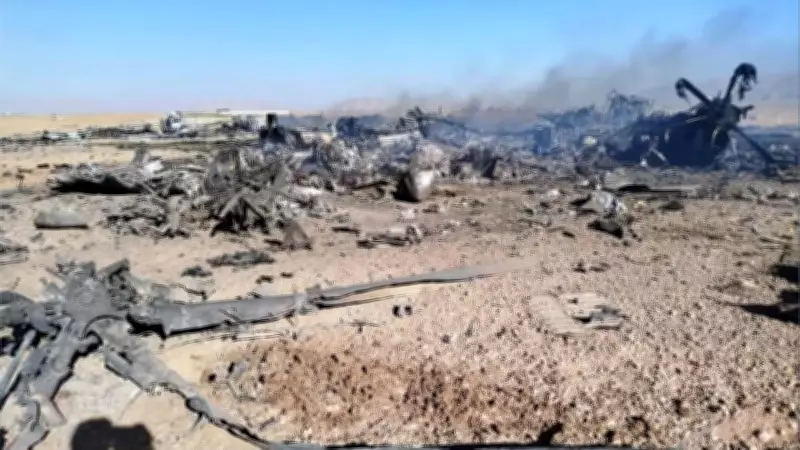
US Intelligence Warns: Iran Retains Thousands of Missiles Despite Heavy Strikes
According to recent American intelligence assessments cited by The Wall Street Journal, Iran continues to hold thousands of ballistic missiles and maintains the capacity to reconstruct parts of its arsenal. This revelation comes despite sustained military strikes by the United States and Israel that have significantly degraded Iran's missile program.
Nuanced Picture of Iran's Missile Capabilities
While US Defense Secretary Pete Hegseth recently declared Iran's missile program "functionally destroyed" and "almost completely ineffective," intelligence officials present a more complex reality. They indicate that although more than half of Iran's missile launchers have been destroyed, damaged, or buried, many could potentially be repaired or retrieved from underground storage facilities.
US and Israeli officials confirm that Iran's missile stockpile has been roughly halved during the conflict, but the country still retains thousands of short- and medium-range ballistic missiles. This persistent capability raises concerns about regional stability as Washington pushes for a ceasefire aimed at reopening the Strait of Hormuz and preventing further escalation involving Iran, US forces, and regional states.

Underground Infrastructure: Key to Iranian Resilience
A critical factor in Iran's continued missile capability is its extensive network of underground missile complexes. Several launchers remain trapped but intact beneath mountains or within reinforced facilities. Officials suggest these could be excavated or restored over time, providing Iran with a pathway to recovery.
Israeli estimates indicate that approximately two-thirds of Iran's ballistic missile launchers were taken out of action during the war. However, they caution that many systems are recoverable. Intelligence assessments suggest Iran still possesses over 1,000 medium-range missiles out of an estimated 2,500 at the conflict's outset.
Drone Depletion and Cruise Missile Concerns
Iran's drone inventory has been sharply reduced, with US officials estimating the country now holds well under half of its pre-war stock of one-way attack drones. Despite this depletion, concerns persist that Tehran could source similar systems externally, potentially from Russia.
The country also retains a limited number of cruise missiles, which could be deployed to target maritime routes in the Persian Gulf or US forces in the region if hostilities resume. This remaining capability continues to influence regional security dynamics.
US Claims Success Amid Analyst Caution
Senior US officials maintain that the military campaign has significantly degraded Iran's capabilities. Chairman of the Joint Chiefs of Staff Dan Caine reported that over 13,000 munitions were used to strike missile sites, storage facilities, naval assets, and defense infrastructure.
Caine stated the strikes were aimed "to ensure that Iran cannot reconstitute the ability to project power outside their borders." The White House has reiterated that US objectives were achieved, with spokesperson Anna Kelly calling it a "profound military success."
However, analysts warn that Iran's ability to recover, even partially, could sustain its role as a key regional power. Jon Alterman of the Center for Strategic and International Studies told The Wall Street Journal, "One of the huge takeaways of this is that Iran, with a tiny fraction of its earlier capability, can still be the dominant actor controlling peace and security in the Gulf."
Long-Term Rebuilding Uncertain
US analysts do not expect Iran to quickly return to pre-war missile and drone levels, given extensive damage to its defense industrial base. Israeli officials say Iran currently lacks the capacity to manufacture new missiles at scale.
Future rebuilding efforts will likely depend on external support, particularly from countries like Russia or China, as well as the trajectory of sanctions and export controls. Iran has historically relied on its missile arsenal to compensate for a relatively weak air force and project power in the region.

Alterman added, "They have this great advantage that every day they don't lose, they win, and every day we don't win, we lose." This perspective highlights the strategic implications of Iran's remaining missile capabilities, which continue to shape security dynamics in the Middle East despite significant degradation from military strikes.