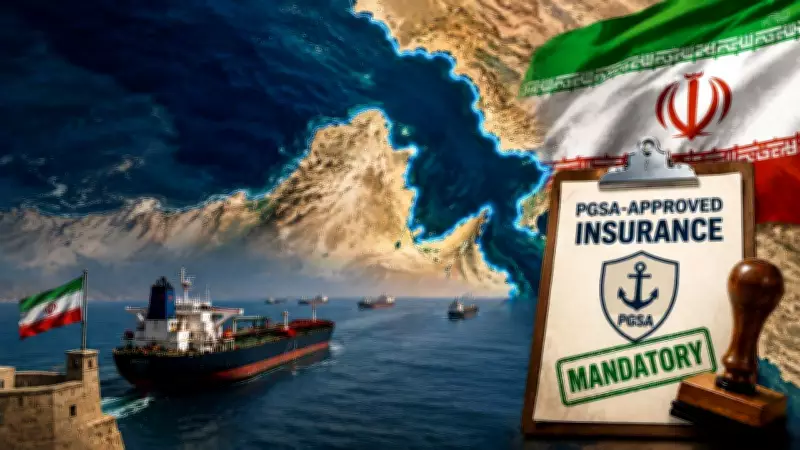
Iran has signaled that it may introduce insurance-linked charges for ships passing through the Strait of Hormuz, a move that has sparked concerns in the global shipping industry about Tehran's efforts to establish a new regulatory regime over one of the world's most critical maritime chokepoints, according to a report by the Financial Times.
New Insurance Requirements
In a document circulated among shipping executives and reviewed by the publication, Iran's newly created Persian Gulf Strait Authority (PGSA) stated that "all vessels must hold a valid insurance policy approved by the PGSA." While the insurance requirement will be provided "free of charge" for now, the authority said it "reserves the right to introduce insurance fees in the future, which will be determined by the relevant insurer."
Context of the Interim Agreement
The development comes weeks after the interim US-Iran peace agreement, under which Tehran agreed to restore maritime traffic through the Strait of Hormuz to pre-war levels and refrain from imposing charges on vessels for 60 days. Industry observers told the Financial Times that the insurance provision reinforces concerns that Iran is laying the groundwork for a system under which ships would eventually have to pay for passage through the strategic waterway. Such a move could raise questions under international maritime law, including provisions related to free passage through international waterways under the United Nations Convention on the Law of the Sea.

Iranian Official's Comments
An Iranian official familiar with the discussions told the Financial Times: "The text of the memorandum of understanding is clear. For a period of 60 days from the date the MoU entered into force, vessel traffic will be carried out without any charges being collected." The official added that after the 60-day period, Iran and Oman would determine a future framework that "will likely include fees related to service provision and safe passage." According to the report, the official said discussions with Oman and regional countries are still underway and that "the text states that this will be done in consultation with the countries of the region."
Oman's Stance
Oman, whose territorial waters cover part of the strait, has previously opposed tolls for passage. However, a person briefed on the matter told the Financial Times that Muscat was considering "lawful charges" linked to environmental protection measures and "enhanced navigational management including pilotage and security."
Contentious Negotiations
The issue has emerged as one of the most contentious aspects of ongoing negotiations between Washington and Tehran. Under the interim agreement, Iran is expected to hold talks with Oman and Gulf states "to define the future administration and maritime services in the Strait." The agreement states that any future arrangement should be "in line with the applicable international law and the sovereign rights of coastal states."
Navigation Instructions and Security Concerns
The Financial Times also reported that Iran's PGSA has issued detailed navigation instructions for ships transiting the strait, including designated coordinates for shipping lanes near the Iranian coast. "Any deviation from or use of alternative routes is strictly prohibited and will be treated as a violation," the PGSA said. The directive has complicated planning for ship operators, particularly because the PGSA itself remains under US sanctions. Shipping companies are also weighing security concerns amid fears that mines may have been deployed in parts of the waterway during the recent conflict.

Recent Incidents
Separately, two people familiar with the situation told the Financial Times that Iranian forces fired warning shots in the Strait of Hormuz on Friday and issued a radio broadcast to vessels in the area. The broadcast stated: "Given that the withdrawal of Israel from Lebanon, the complete lifting of the naval blockade, and the departure of American terrorist forces . . . are core conditions for an agreement between Iran and the United States, the Strait of Hormuz will remain closed until these two conditions are met." It added: "All vessels are hereby instructed to avoid approaching the Strait of Hormuz for their own safety and security. Any vessel that disregards this order will be targeted." According to the report, Tehran had previously proposed charging ships $2 million in cryptocurrency for passage through the strait.
Impact on Maritime Traffic
The uncertainty has also affected maritime traffic. Despite a rush of vessels attempting to leave the Gulf on Thursday, shipping activity remained subdued on Friday as concerns grew over renewed tensions following Israeli strikes in Lebanon. International Maritime Organization Secretary-General Arsenio Dominguez said efforts were continuing to establish a humanitarian corridor for stranded seafarers. "We are also gathering necessary security guarantees — to ensure that all transits will be free from any hazards including potential mines," Dominguez told FT.
Global Significance
The Strait of Hormuz remains one of the world's most important energy arteries, historically carrying about one-fifth of global oil and liquefied natural gas shipments. Any move by Iran to formalize fees, insurance requirements or administrative controls over the waterway is likely to face intense scrutiny from shipping companies, regional governments and major global powers.