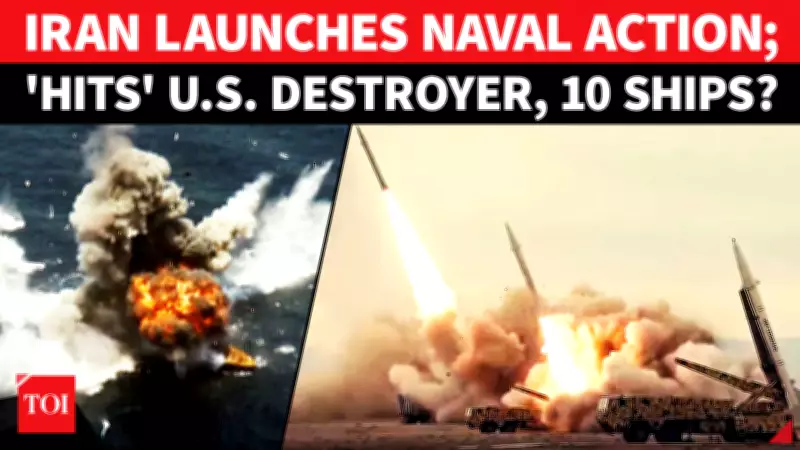
Iran Launches Major Missile Strike Against US Navy Destroyer in Indian Ocean
The ongoing conflict between Iran and the United States has dramatically escalated into open international waters, with Iran's Islamic Revolutionary Guard Corps (IRGC) claiming responsibility for a significant missile attack targeting an American naval vessel. According to official statements from Tehran, this represents a major expansion of hostilities beyond previous engagements.
Details of the Naval Attack
The IRGC reported that their forces successfully struck a U.S. Navy destroyer in the Indian Ocean using advanced missile systems during what they described as a "powerful and precise strike." Iranian military officials specified that Ghadr-380 medium-range ballistic missiles and Talaieh strategic cruise missiles were deployed in the attack, which occurred while the American warship was reportedly refueling from a U.S. military tanker.
Notably, the targeted vessels were positioned more than 600 kilometers from Iran's territorial borders, indicating the extended reach of Iran's military capabilities. Iranian sources claimed the missile strikes triggered "widespread and serious fires" aboard both the destroyer and the accompanying tanker, though independent verification of these damage assessments remains pending.

Strait of Hormuz Declared Active War Zone
In a parallel development with significant implications for global energy markets, the IRGC formally declared the strategically vital Strait of Hormuz a "designated war zone" following the naval engagement. Iranian forces reported targeting more than ten commercial oil tankers that had allegedly ignored Iranian warnings to avoid the area.
This declaration and subsequent attacks on maritime traffic represent a serious escalation that could potentially disrupt a critical chokepoint for international oil shipments, through which approximately one-fifth of the world's petroleum passes annually.
Multi-Front Military Escalation
The naval confrontation forms part of a broader pattern of intensified hostilities across multiple theaters. Iranian military forces simultaneously reported conducting drone and missile attacks targeting American military installations in Erbil, Iraq and Kuwait, signaling a coordinated multi-front offensive strategy.
This expansion of conflict across land, air, and sea domains represents a significant intensification of the Iran-U.S. confrontation, with regional stability and international shipping lanes now directly impacted by the escalating tensions between Tehran and Washington.
The latest developments follow a series of previous confrontations and come amid heightened regional anxieties about the potential for broader conflict involving multiple state and non-state actors across the Middle East.