

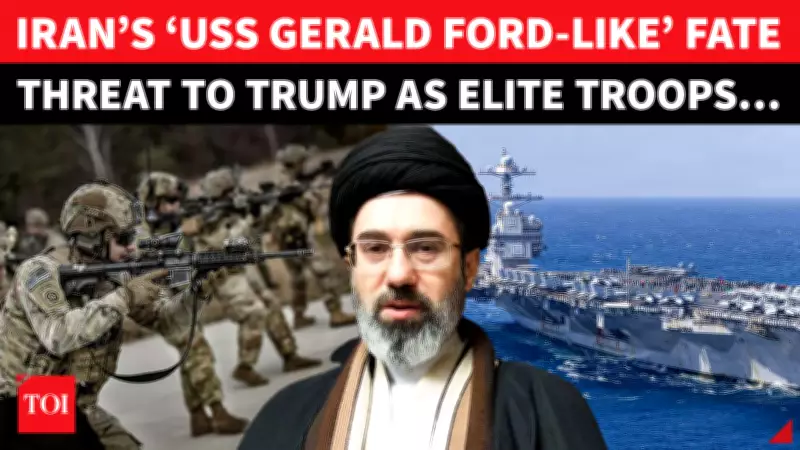
IRGC Issues Grave Warning to Trump Over Potential US Troop Deployment
Iran's formidable Islamic Revolutionary Guard Corps (IRGC) has delivered a chilling and unambiguous warning to the United States, directly invoking the fates of American aircraft carriers as a stark precedent. The warning comes amid serious considerations in Washington to deploy a significant contingent of elite troops to the volatile region, a move that threatens to dramatically escalate the ongoing Iran versus US-Israel conflict.
Invoking the Fate of US Naval Power
The IRGC's statement specifically referenced iconic US Navy vessels, including the USS Gerald R. Ford and the USS Abraham Lincoln, suggesting that US forces could meet a similar, ominous destiny. This rhetorical escalation is not merely symbolic; it underscores the high-stakes environment where military posturing is intertwined with historical and psychological warfare.
The core of the warning centers on reports that the US is contemplating the deployment of approximately 3,000 soldiers from its prestigious 82nd Airborne Division. This elite rapid-deployment force is a key instrument of American power projection, and its potential movement into the Middle East is being interpreted as a major signal of Washington's hardening stance.

Escalation Amid Deepening Regional Crisis
This development occurs against a backdrop of intensifying hostilities and a series of recent incidents that have pushed the region closer to the brink of a wider war. Analysts point to a dangerous cycle of action and reaction, with both Iran and the US-Israel alliance adopting increasingly inflexible positions.
The potential deployment of the 82nd Airborne represents a tangible step-up in military readiness, moving beyond aerial strikes and naval blockades to the positioning of substantial ground forces.Key factors contributing to the current crisis include:
- Ongoing proxy conflicts and direct strikes between Iranian-backed groups and US/Israeli assets.
- A breakdown in diplomatic channels and the collapse of previous negotiation frameworks.
- Regional instability affecting Gulf nations and international shipping lanes.
- The strategic calculations of global powers, including Russia's alleged role in aiding Iranian capabilities.
Growing Fears of a Wider Regional Conflagration
The IRGC's stark message amplifies existing fears that the conflict could spiral beyond its current confines. Military experts warn that the introduction of a major US Army division could trigger a proportional response from Iran and its network of allied militias across the Middle East.
The situation presents a critical test for crisis management, as miscalculation or an unintended incident could quickly lead to a full-scale regional war with devastating humanitarian and economic consequences. The international community watches with apprehension as diplomatic solutions appear increasingly elusive and military posturing takes center stage.
In summary, the IRGC's warning to the Trump administration, coupled with the serious prospect of deploying the 82nd Airborne Division, marks a perilous new phase in the Iran-US confrontation. The explicit reference to US aircraft carriers serves as a grim reminder of the high costs of conflict, even as both sides appear to be preparing for its potential inevitability.






