

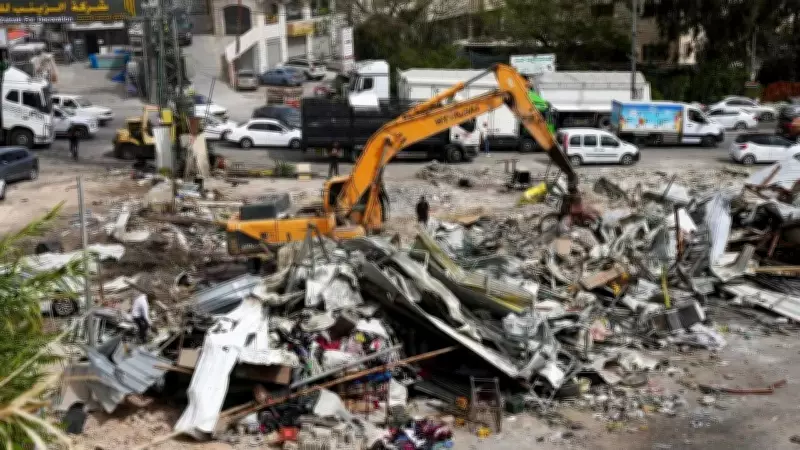
Israeli bulldozers demolished dozens of Palestinian-owned shops on the outskirts of al-Eizariya, a town southeast of Jerusalem, earlier this week. The clearing is part of land preparation for a road project associated with settlements in the occupied West Bank.
Conflicting Justifications
Israeli authorities claim the demolitions are necessary to build a road that will serve Palestinian communities, alleviating congestion and improving quality of life. However, Palestinian officials argue that the road is part of a broader plan to reroute Palestinian traffic away from a new highway serving nearby Israeli settlements. This project is located in the strategic E1 area of the West Bank, which Israel is developing in a manner that critics say prevents the establishment of a contiguous Palestinian state.
Hagit Ofran, director of the anti-settlement group Peace Now, stated, "The shops that were demolished are where Israel is planning to build a new road that will divert all Palestinian traffic to that road so that they can close down the whole area of E1 for Palestinians."

Demolition Details
The demolitions occurred on Tuesday, less than a week after some shop owners received evacuation notices for structures built without permits. Attorneys appealed the orders up to Israel's Supreme Court, but the demolitions proceeded regardless. Israeli authorities said the buildings, which included car washes, scrap metal shops, and vegetable stands, were constructed illegally and that owners had been warned for "several years" that enforcement was imminent.
COGAT, the Israeli military body overseeing civil affairs in the West Bank, stated that the structures obstructed the planned road connecting Palestinian towns. The new road system is intended to solve congestion and improve the quality of life for Palestinians in the area, according to Israel.
Broader Context
Rights groups and the internationally backed Palestinian Authority contend that the demolitions are tied to Israel's plans to overhaul transportation and create separate road systems for Israeli and Palestinian ID holders. They allege that Israel's planned tunnel-and-bypass road will reroute Palestinian traffic off a major Israeli highway linking West Bank settlements to Jerusalem, effectively cutting off drivers from large parts of the territory.
Some of the demolished shops partially blocked sidewalks and roads leading into the town. However, Palestinians assert that obtaining proper construction permits from Israeli authorities is nearly impossible, even as Israeli settlements expand rapidly.
Mohammad Abu Ghalieh, a 48-year-old shop owner, expressed disbelief at having to start over after the demolitions. "Forty-eight years of night and day to build something for his children and himself, and in one day and one night, everything was gone," he said.
Daoud al-Jahalin, head of the nearby village council, warned that more than 200 families would lose their incomes as a result.
The E1 Project
The E1 project is particularly contentious because it extends from the outskirts of Jerusalem deep into the occupied West Bank, isolating the cities of Ramallah and Bethlehem and hindering north-south movement for Palestinians. Both Israeli leaders and settlement critics agree that the E1 plan would complicate efforts to establish a contiguous Palestinian state. Israel plans to build around 3,500 apartments next to the existing settlement of Maale Adumim.
Israel captured the West Bank in the 1967 Mideast War. The international community overwhelmingly considers Israeli settlement construction in occupied territory to be illegal and an obstacle to peace.






