

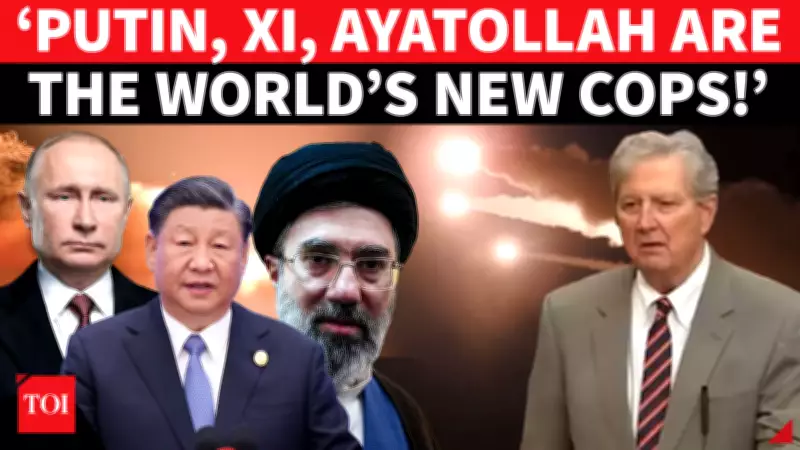
Senator John Kennedy has raised alarms over what he perceives as a burgeoning strategic partnership among Chinese President Xi Jinping, Russian President Vladimir Putin, and Iran’s Supreme Leader Ayatollah Ali Khamenei. In a stark warning, Kennedy asserted that these three leaders share ambitions to expand their influence across critical regions, including Eastern Europe, the Middle East, and the Indo-Pacific. He characterized Xi as the “managing partner” of this alliance, emphasizing that the emerging bloc poses a significant challenge to U.S. interests and global stability.
Kennedy's Urgent Call to Action
Kennedy urged the United States to recognize the gravity of this threat and prepare to confront it before the balance of power shifts further. He argued that the collaboration among these authoritarian leaders could undermine decades of American-led international order. The senator's comments come amid growing concerns over deepening ties between Russia, China, and Iran, which have been cooperating on military, economic, and diplomatic fronts.
Implications for Global Security
Analysts note that the coordination among these nations could embolden aggression in regions like Ukraine, the South China Sea, and the Persian Gulf. Kennedy’s warning reflects a broader anxiety among Western policymakers about the erosion of U.S. influence and the rise of a multipolar world order. He stressed that without a robust response, the United States could find itself increasingly isolated and challenged on multiple fronts.

The senator’s remarks have sparked debate among foreign policy experts, with some calling for a more assertive strategy to counter the alliance, while others caution against overreaction. Nonetheless, Kennedy’s alarm underscores the perceived urgency of addressing this evolving geopolitical landscape.






