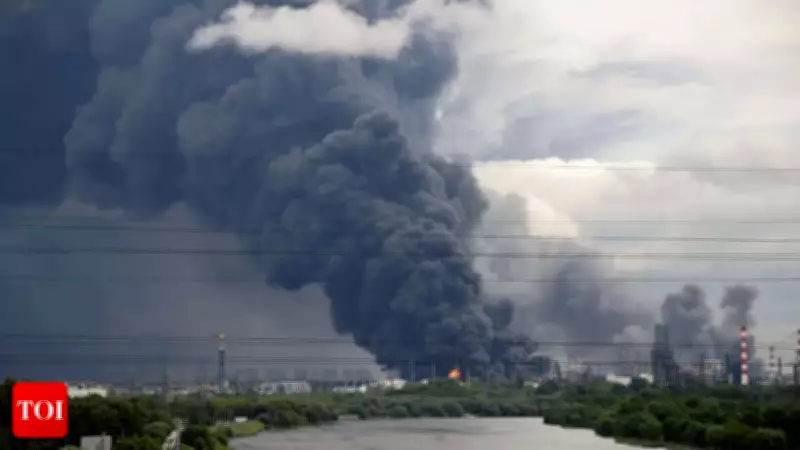
Moscow experienced its largest Ukrainian drone attack since Russia's full-scale invasion began in 2022, officials from both sides confirmed. Nearly 200 drones targeted the Russian capital, while air defenses across the country intercepted almost 1,000 unmanned aerial vehicles and four Ukrainian cruise missiles within 24 hours.
Massive Barrage and Damage
Russia's defense ministry reported that its forces destroyed "almost 1,000 drones and four cruise missiles" launched from Ukrainian territory. The barrage included close to 200 drones that struck targets around Moscow, sending huge plumes of black smoke across the city and forcing temporary closures at four airports. Over 500 flights were canceled or delayed due to the attack.
The assault caused multiple fires, most notably at the Kapotnya oil refinery in southeastern Moscow, which was hit for the third time in a month and the second time this week. Videos widely shared on social media showed the lid of a large oil storage tank hurled dozens of meters into the air by a powerful blast. A nearby shopping center also caught fire after debris reportedly fell on the building, and several residential high-rises were evacuated.

Local authorities reported 17 people wounded in the Moscow region, according to Governor Andrei Vorobyov. An oil depot in Russia's southern Rostov region was also struck, where officials reported one fatality. While authorities have sought to limit coverage of the strikes inside Russia by banning publication of images of the aftermath, dozens of videos showing drones and explosions were posted online.
Ukraine's Response and Strategy
President Volodymyr Zelensky framed the operation as a response to last week's Russian assault on Kyiv, which set a major religious landmark ablaze. "We don't want this war and have never wanted it," he said, insisting that Kyiv's long-range raids aim to pressure Moscow into pursuing diplomacy. "But if Ukraine burns, your Moscow will burn too," he warned, calling the strikes "long-range sanctions"—a deliberate euphemism Ukraine uses to emphasize targeting of Russian infrastructure and military assets.
The scale of the latest operation underscores how Kyiv's long-range strike capabilities have grown since the first successful drone incursions into Moscow in spring 2023.
Why This Attack Is Different
Those early attacks were small and sporadic. In contrast, the latest wave used hundreds of drones in a coordinated fashion to overwhelm air defenses and reach deep into Russian territory, roughly 500 kilometers from the Ukrainian border. Moscow has gradually fortified its air defenses around the capital with layered systems intended to intercept incoming missiles and drones. However, analysts say Ukraine's increased production and operational tempo for lower-cost drones, along with increasingly sophisticated attack packages and routing tactics, have raised the chances of successful penetrations.
The strikes mark an escalation in what has become an increasingly cross-border and attritional phase of the war. While much of the fighting remains concentrated along front lines inside Ukraine, Kyiv's ability to strike Russian military sites, energy infrastructure, and logistics nodes—and to show those effects to a global audience—is central to its strategy of "bringing the war home" to Russian citizens and eroding domestic political support for the Kremlin's policies.
Russia's Continued Strikes
Russia, for its part, continued its own overnight strikes on Ukraine. Kyiv reported that Moscow launched more than 200 drones and multiple ballistic missiles at Ukrainian territory in a separate barrage. Russian President Vladimir Putin, hosting Southeast Asian leaders at a summit in Kazan, had not publicly commented on the large-scale attack on Moscow by the time of reporting.
Ukrainian Foreign Minister Andriy Sybiha wrote on social media that ordinary Muscovites were only now seeing the consequences of a war Moscow began, urging them to ask their leaders when it will end. As both sides trade strikes deeper into each other's territory, experts warn the conflict risks further escalation and continued damage to civilian infrastructure far from the front lines.