

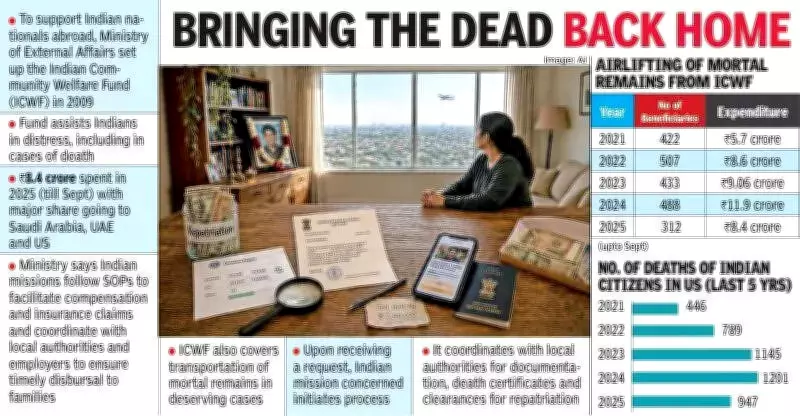
Hyderabad: With 4,528 Indian nationals reported dead in the US over the past five years, the repatriation of mortal remains is drawing increasing scrutiny. Funeral homes, Indian associations and volunteers say the growing trend of families raising funds through multiple channels is raising concerns over transparency and possible misuse.
High Costs of Repatriation
Repatriation of mortal remains from the US to India is expensive, often costing upwards of Rs 9 lakh. "The average cost is around $9,800 (about Rs 9.07 lakh), but it varies depending on the place of death, airline and procedural requirements," said Robert of Melendez Funeral Home in New York. His firm handled around 120 international repatriations in 2025, with Indians accounting for nearly a quarter.
Multiple Fundraising Sources
Given the high costs, families have long relied on crowdfunding platforms like GoFundMe. But associations say there is now a shift towards tapping multiple sources simultaneously — community groups, embassies and insurance — a trend some describe as "exploitative". "We have always worked closely with Indian consulates, which have been very supportive. However, the surge in fundraising — both online and offline — has led to instances of misuse. Consulates now verify whether funds are being raised elsewhere before extending assistance," said Ashok Kolla of the Telangana Association of North America.

Associations and volunteer groups also point out that many Indian immigrants are covered by insurance, which can significantly reduce costs. "Most students and working professionals have insurance by default," said Mohan Nannapaneni of Team Legal Aid, which facilitated over 700 repatriations across the US, Mexico and Canada last year. Emphasizing accountability, he added, "We are a voluntary organisation working closely with embassies and government agencies. Before stepping in, we verify whether funds are being raised elsewhere."
Process Timelines
Despite perceptions of delays, funeral homes say the process itself is relatively swift. "Most international cases are completed within 48 hours from first contact to consulate clearance. Flight bookings typically take another 24 hours," Robert said. Associations, however, note that fundraising often continues even after formalities are completed. "Local funeral homes handle nearly 90% of the process — embalming, death certificates, non-contagious certificates, permits and preparation in zinc-lined caskets. They also coordinate transfers to major cities where required," Kolla said.
Red Flags
While many cases are genuine, associations say a growing number raise red flags. Vishweshwar Reddy Kalavala, founder of Global Telangana Association in Washington DC, said funds are sometimes raised beyond immediate needs. "In some cases, money is used to repay loans or fund family travel. While those needs may be valid, mobilising funds from all possible sources raises serious concerns," he said.
More troubling, they add, are cases where financially stable families seek public donations without full disclosure. "We've seen instances where well-off families still launch fundraisers for basic amounts. It raises questions," Kolla said, citing a case involving a young woman who died in Seattle. Associations have also flagged a lack of transparency in some cases, particularly when the cause of death is withheld. According to Kalavala, there has been an "unprecedented rise" in deaths linked to suicides, drug overdoses and, in some cases, violent crimes. "These often involve legal complexities. But in trying to expedite repatriation or attract financial support, key details are sometimes concealed," he said.
Government Support
To support Indian nationals abroad, the Ministry of External Affairs set up the Indian Community Welfare Fund (ICWF) in 2009. The fund assists Indians in distress, including in cases of death. According to MEA data, about Rs 8.4 crore was spent in 2025 (till September), with a significant share going to countries such as Saudi Arabia, the UAE and the US. In an official statement, the ministry said Indian missions follow standard procedures to facilitate compensation and insurance claims and coordinate with local authorities and employers to ensure timely disbursal to families.

The ICWF also covers the transportation of mortal remains in deserving cases. Upon receiving a request, the concerned Indian mission initiates the process, coordinating with local authorities for documentation, death certificates and clearances for transportation to India. Assistance is means-tested, with each request examined by a welfare or consular officer and a three-member committee at the mission.





