

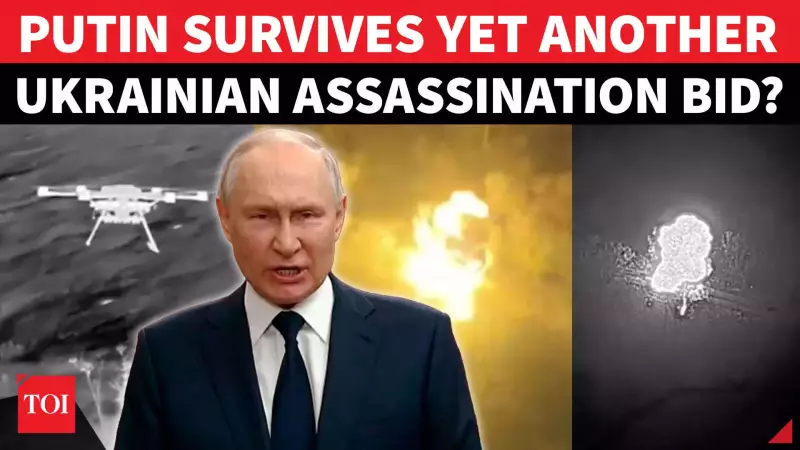
In a dramatic escalation on New Year's Eve, the Russian capital Moscow came under a sustained drone attack allegedly launched by Ukraine. The incident unfolded as President Vladimir Putin was delivering his annual televised address to the nation, marking a stark start to the year 2026.
Drones Intercepted During Presidential Address
According to officials in Moscow, multiple long-range unmanned aerial vehicles (UAVs) were intercepted as they approached the city. The timing was highly symbolic, with city authorities confirming that one drone was shot down just as President Putin began his traditional New Year's Eve speech. The air defence operations continued into the early hours of New Year's Day, indicating a coordinated and prolonged assault.
This attack was not an isolated event. It followed another significant drone raid just a day earlier, on December 30, which reportedly wounded at least one civilian. The back-to-back incidents suggest an intensification of long-range drone warfare targeting the Russian heartland.

Disruption and Official Response
The drone incursion caused immediate operational disruptions. Flights at Moscow's Domodedovo Airport were temporarily suspended as a security precaution, affecting holiday travel. Emergency services were deployed to several crash sites across the region to handle debris and any resultant damage.
The Russian government's reaction was swift and severe. Moscow has officially labelled the aerial assaults as "acts of terrorism" and issued a stern warning. Russian officials stated that such attacks would be met with a "non-diplomatic response," hinting at further military escalation and retaliation beyond the realm of political dialogue.
Context of a Protracted Conflict
This event underscores the evolving nature of the Russia-Ukraine war, now extending into its fourth year. The use of long-range drones to strike deep inside Russian territory, including its political centre, represents a significant tactical shift for Ukrainian forces. It demonstrates their capability to project power and challenge the sense of security far from the front lines.
The attack on a symbolic occasion like New Year's Eve, during a major national broadcast by the Russian president, carries a heavy psychological and propaganda weight. It is seen as a direct challenge to the Kremlin's authority and a message that the war's consequences will reverberate within Russia itself.
As the new year begins, this incident sets a tense precedent, with Russia's promise of a robust, non-diplomatic answer likely shaping the conflict's trajectory in the coming weeks. The international community watches closely as these developments threaten to further destabilise the region.






