

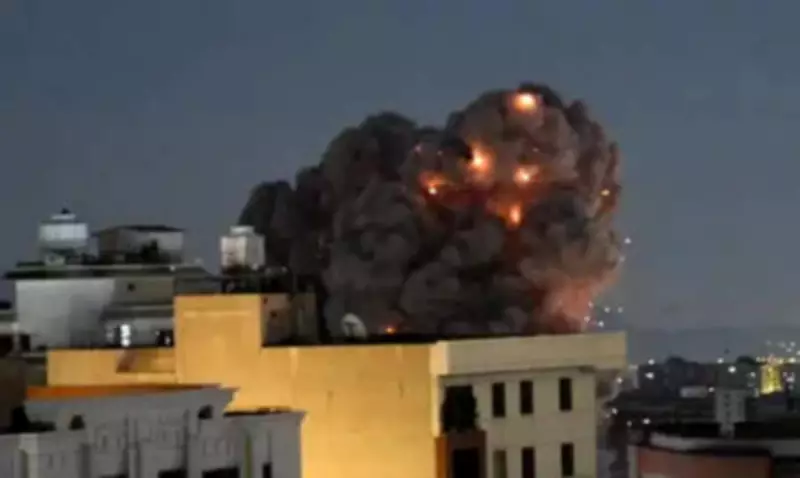
US-Israel-Iran War Intensifies: Six Children Killed in Tehran Strike, Trump Issues Stark Warning
The ongoing conflict between the United States, Israel, and Iran has entered a critical phase with devastating consequences. Iranian state media reported on Monday that six children were killed in a coordinated US-Israeli attack on Tehran's residential areas early in the morning. This tragic development comes as US President Donald Trump prepares to address the media regarding the escalating Middle East crisis.
Trump's Deadline and Military Threats
President Trump has issued a direct warning to Iran, threatening military action if Tehran fails to reopen the strategically vital Strait of Hormuz. In a strongly worded post on his Truth Social platform, Trump declared: "Tuesday will be 'Power Plant Day' and 'Bridge Day' in Iran—unlike anything seen before. Open the Strait, or face severe consequences."
The Strait of Hormuz represents a crucial global shipping corridor, with approximately 20% of the world's crude oil supply passing through it. Iran's effective blockade of this waterway in retaliation for US-Israeli actions has raised significant concerns about global energy market stability.

Rescue Operation and Diplomatic Efforts
During his upcoming briefing, Trump is expected to provide details about the successful rescue of two American pilots whose F-15E aircraft was shot down by Iranian air defense systems on Friday. One pilot was recovered shortly after ejecting, while the weapon systems officer—identified as a US Air Force colonel—was rescued in a separate operation conducted by US special forces.
Israeli Prime Minister Benjamin Netanyahu praised the operation, tweeting: "I spoke earlier with President Trump and personally congratulated him on his bold decision and a perfectly executed American mission to rescue the downed pilot from enemy territory."
Ceasefire Negotiations Under Pressure
As Trump's deadline approaches, mediators are making a final push for a 45-day ceasefire that could potentially lead to a permanent end to hostilities. According to sources cited by Axios, the United States, Iran, and regional mediators are discussing terms for this temporary truce, though chances of reaching a partial deal within the next 48 hours remain slim.
Mediators have warned Iranian officials that there is no time for further negotiation tactics, emphasizing that the next two days represent the last opportunity to prevent massive destruction to Iranian civilian infrastructure. These last-ditch efforts aim to avert a dramatic escalation that could include strikes on Iranian infrastructure and retaliatory attacks against energy and water facilities in Gulf states.
Regional Impact and Responses
The conflict has already claimed numerous civilian lives beyond the six children killed in Tehran. The mortal remains of 25-year-old Indian seafarer Dixit Solanki, killed in a suspected drone boat attack off the Oman coast last month, have been repatriated to Mumbai. His family received the remains after approaching the Bombay High Court seeking clarification from authorities.
Iranian parliamentary speaker Mohammad Baqer Ghalibaf strongly criticized Trump's threats, warning that such actions could have serious consequences for both the United States and the wider region. In a social media post, Ghalibaf accused Trump of escalating tensions and risking widespread instability, suggesting Washington's actions are aligned with Israeli interests.
Economic and Transportation Fallout
The conflict has disrupted regional operations across multiple sectors. Abu Dhabi-based Borouge PLC confirmed an "incident" at its production facilities located in the Ruwais Industrial Area, a major UAE energy hub housing one of the world's largest oil refineries.
Meanwhile, Indian airline Akasa Air announced it will continue operating flights between Jeddah and several Indian cities—including Ahmedabad, Bengaluru, Mumbai, Kochi, and Kozhikode—based on ongoing safety assessments. The carrier stated it is progressively evaluating the resumption of flights to and from Abu Dhabi while maintaining suspensions for Doha, Riyadh, and Kuwait routes until April 12.

Military Developments and Regional Tensions
Israel's military confirmed completing "a wave of strikes on Iranian terror regime targets in Tehran" on Monday, following reports of attacks on residential areas in the Iranian capital. The conflict, which began with coordinated US-Israeli strikes on Iran on February 28, has now entered its 38th day with no clear resolution in sight.
As tensions continue to escalate across the Middle East, the international community watches anxiously, with global energy markets particularly vulnerable to disruptions in the strategically vital Strait of Hormuz. The coming days will prove crucial in determining whether diplomatic efforts can prevail over military escalation in this increasingly volatile regional conflict.





