

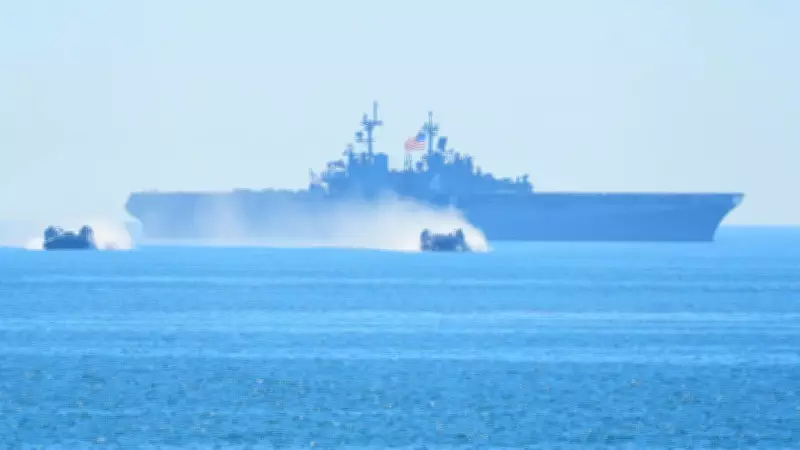
US Deploys Over 2,500 Marines to Middle East Amid Rising Iran Tensions
The United States is significantly escalating its military footprint in the Middle East, with the deployment of thousands of Marines and multiple warships to the region. This strategic move comes as tensions with Iran continue to intensify during the ongoing conflict, marking a critical phase in US military posture.
Massive Marine Deployment and Warship Details
According to Associated Press reports, approximately 2,200 to 2,500 Marines from the elite 11th Marine Expeditionary Unit (MEU) are being transported aboard the USS Boxer Amphibious Ready Group. This deployment could potentially add several thousand additional US forces to the region, supplementing the nearly 50,000 troops already stationed across the Middle East.
The deployment follows nearly three weeks after the US and Israel initiated a large-scale air campaign against Iran. Both nations have engaged in reciprocal drone and missile attacks, including operations that have disrupted the critical Strait of Hormuz, a vital global energy chokepoint handling approximately 20% of worldwide oil trade.

Strategic Rationale Behind the Buildup
US officials have clarified that these additional forces are intended to enhance operational readiness and provide flexible options for future missions. Potential scenarios include evacuation operations, securing crucial sea routes, or even ground action if circumstances demand it. There are ongoing discussions within the US administration about applying pressure on Iran by targeting key oil infrastructure, underscoring the strategic nature of this deployment.
The Three Key Warships Carrying the Marines
USS Boxer: The Floating Assault Base
The USS Boxer, a Wasp-class amphibious assault ship, serves as the lead vessel in this deployment, functioning as a formidable floating military base. Often compared to a small aircraft carrier, it possesses the capability to operate F-35B stealth fighter jets, attack helicopters, and MV-22 Osprey aircraft, granting it substantial airstrike power.
Beyond its aviation assets, the USS Boxer's core mission is to support amphibious assaults, enabling Marines to deploy directly onto hostile shores. The ship accommodates over 2,000 troops along with essential equipment, landing craft, and command systems, making it fully capable of launching and sustaining independent combat operations.
USS Portland: Troop Transport and Logistics Hub
The USS Portland, a San Antonio-class amphibious transport dock, plays a pivotal role in transporting troops, vehicles, and supplies. Designed to carry more than 800 Marines along with heavy equipment, it features a large flight deck that supports helicopters and tilt-rotor aircraft such as the MV-22 Osprey, MH-60S Seahawk helicopters, and CH-53E Super Stallion heavy-lift aircraft.
This vessel also includes a well deck for launching landing craft and amphibious vehicles, facilitating efficient movement from sea to shore. Its primary function is to act as a logistics and transport hub, ensuring sustained operations during extended missions in the region.
USS Comstock: Enabling Amphibious Landings
The USS Comstock, a Whidbey Island-class dock landing ship, is specifically focused on enabling amphibious landings. Equipped to launch and recover landing craft, air-cushion vehicles, and amphibious assault equipment, it is crucial for operations near coastlines.
This vessel supports both combat and humanitarian missions, playing a vital role in delivering troops and supplies during operations. Its capabilities allow the US military to establish a strong foothold in coastal areas, enhancing operational flexibility.

Formidable Amphibious Ready Group
The combined presence of these three warships creates a powerful Amphibious Ready Group, capable of executing airstrikes, troop deployments, and ground operations with precision. In addition to the Boxer group, the US has also deployed the USS Tripoli, another amphibious assault ship carrying the 31st Marine Expeditionary Unit from the Indo-Pacific region, further amplifying US military capabilities in the Middle East.
The strategic importance of the Strait of Hormuz cannot be overstated, as any disruption in this region could have a major impact on global oil prices and energy security, highlighting the high stakes involved in these military movements.





